
Digital
Design

Isabel Lauren Loewe
'A Quiet Place for Loud Thoughts', 2026
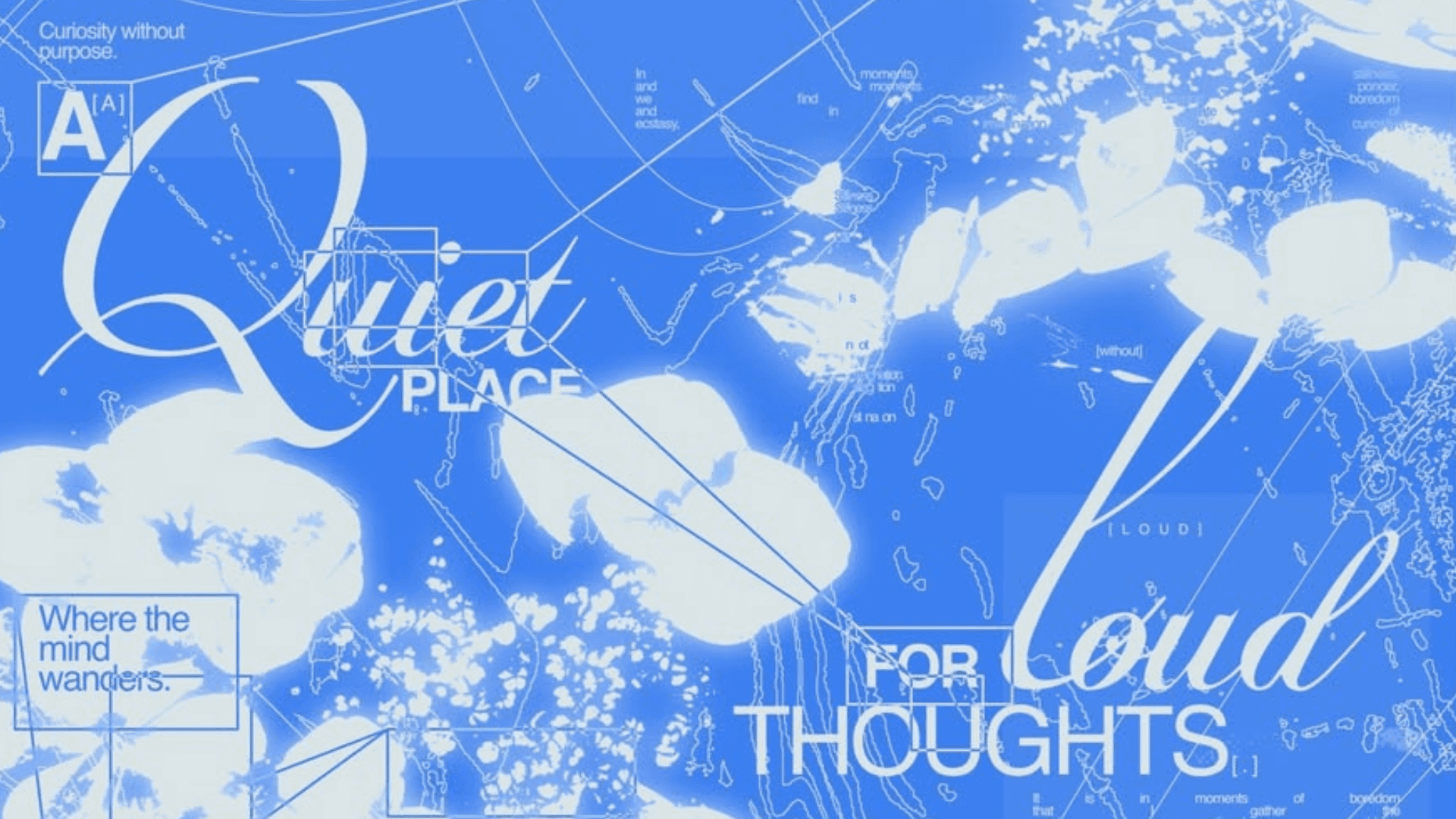
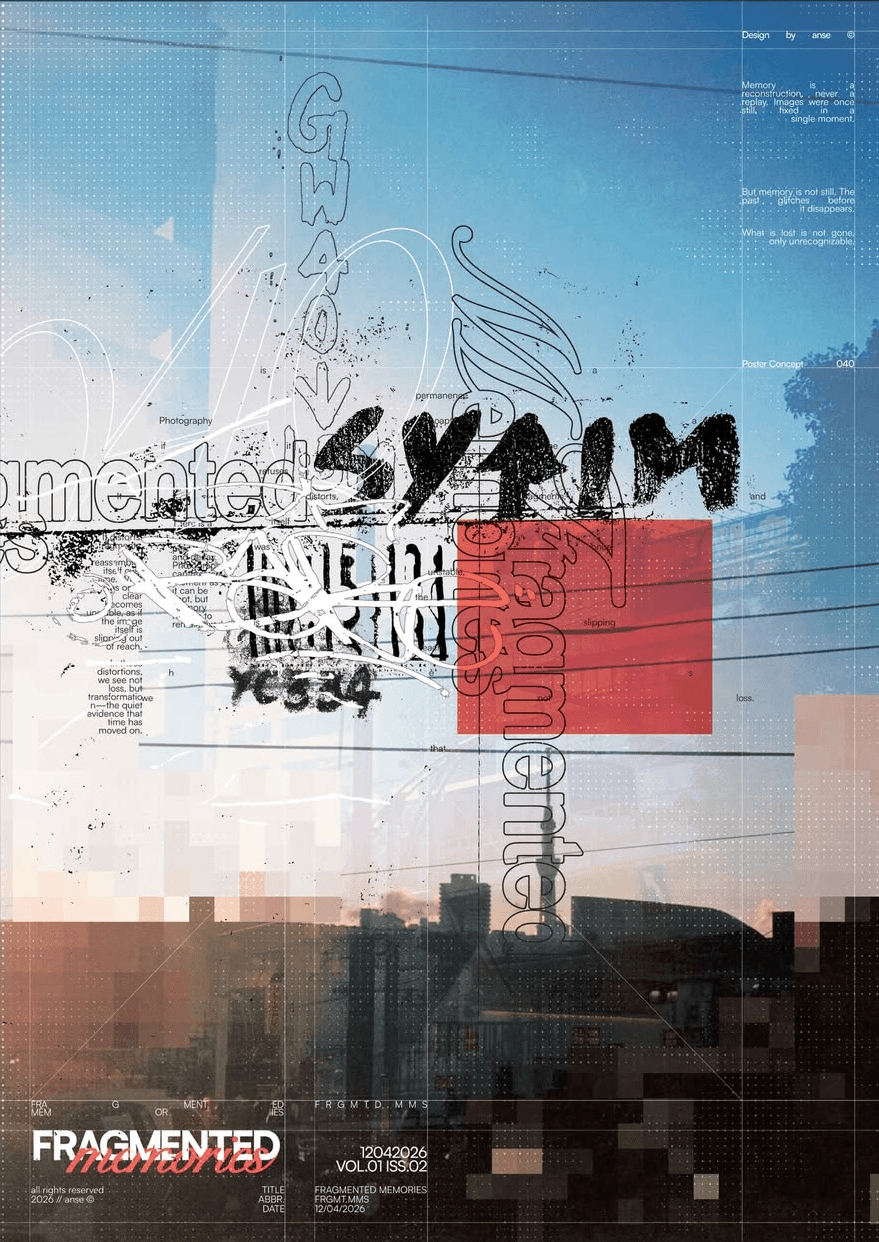
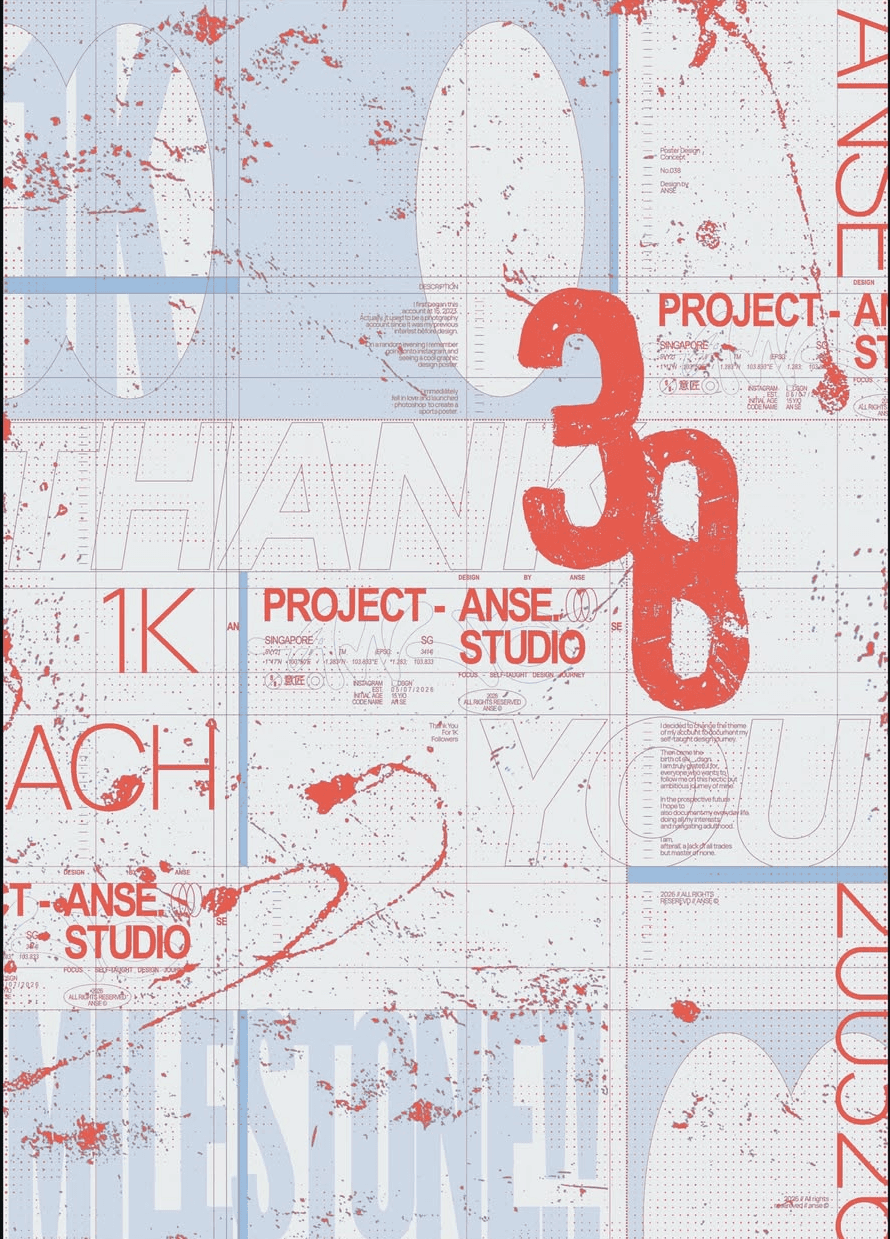
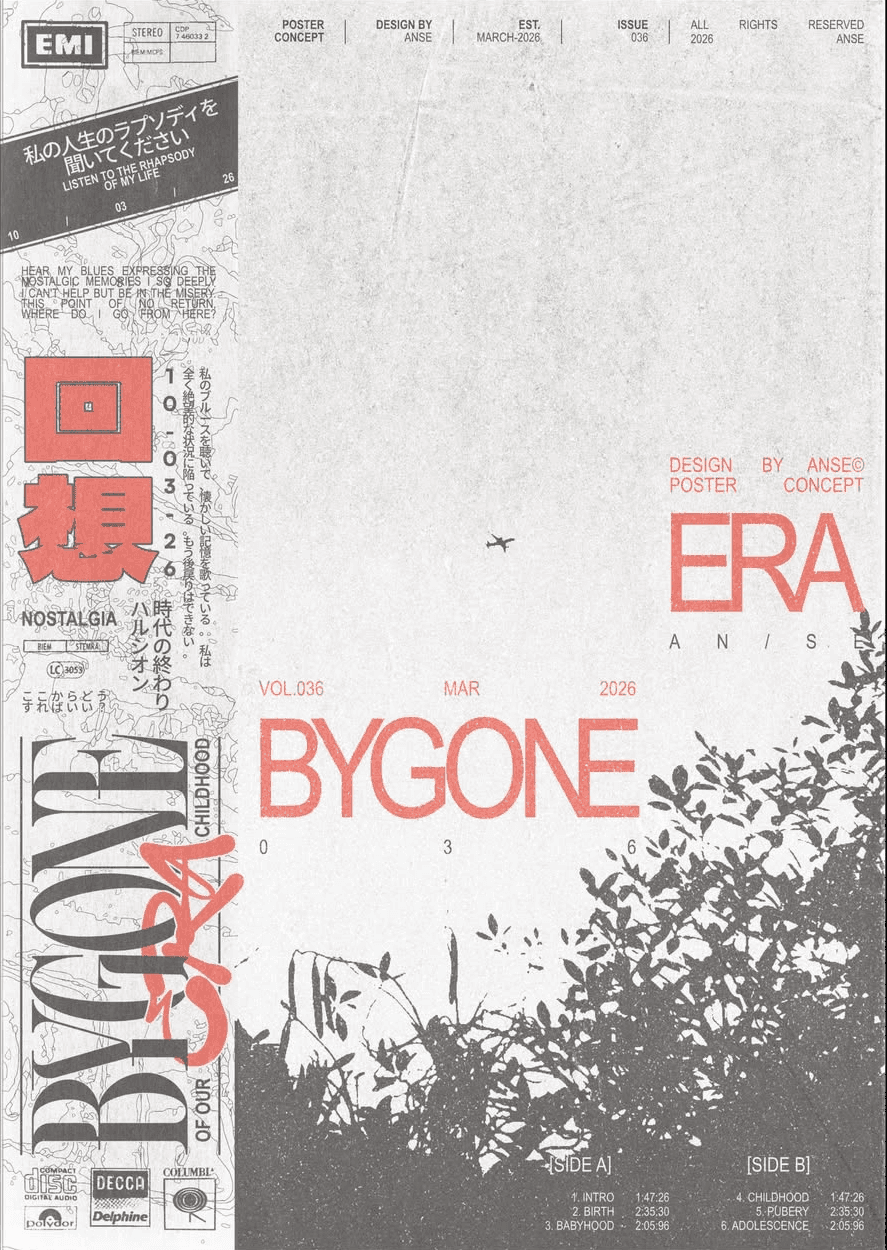
There's a generation of designers who grew up watching design become dominated by minimalist designs and the relentless refinement of everything toward legibility and ease. Anse is moving in the opposite direction. Her posters are built from grunge and layers on top of layers. The type crowds and falls off the page. Images worked over until they’re almost illegible.
She's seventeen, self-taught, and working out of Affinity since losing access to Photoshop when she graduated. Her textures come from what catches her eye on the way to other things: the ground, a wall catching light, an advertisement. She photographs it, pulls it into software, and puts on layers until it feels authentic, almost analog despite originating from digital photography.
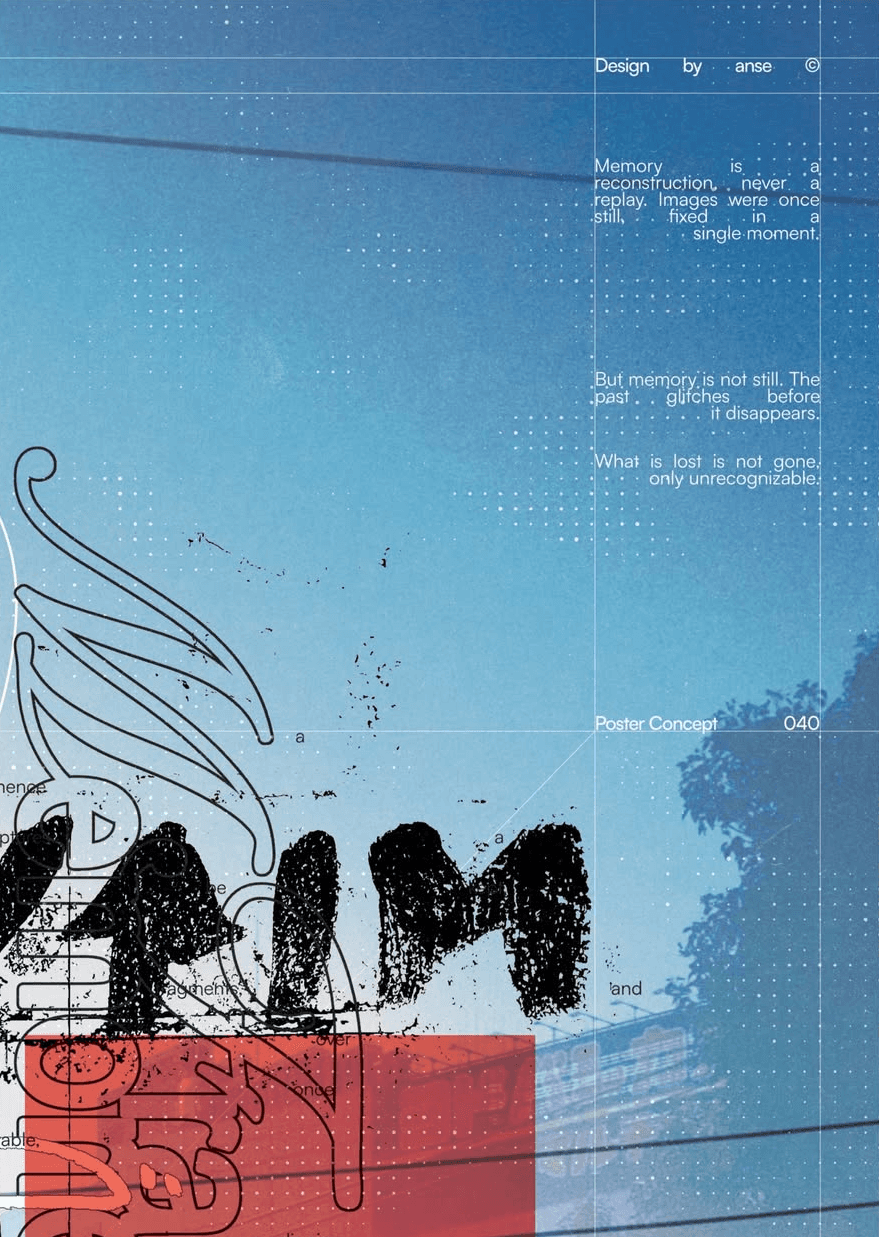
What makes that tension worth paying attention to is that it isn't aesthetic for its own sake. Anse is seventeen and already working from an interest in psychology and the way memory degrades. With her designs, she’s exploring what it felt like to exist before everything became a surface for content. For her, the grunge isn't decoration. The illegibility isn't carelessness. She's building something that looks like it's in the process of being forgotten, which at her age, and with two years of design behind her, is a strange and specific thing to be making.
'Fragmented Memories pt.2', 2026
How would you describe what you make?
I currently make experimental and innovative graphic posters and visual art - using grunge texture, bold typography and avant-garde compositions. My designs do not follow a strict theme, they often begin with curious thoughts during the day, maybe a topic I was interested in. Sometimes they don’t follow a theme until I’ve made a rough layout of its composition.
How did you get started?
It all began at the age of 15 when I tried pursuing a creative passion - which was street photography at first. I created an Instagram account to document these photos, but on a on a random evening watching Instagram reels, I was inspired by a sports poster design. It was energetic, bold and captivating. It influenced me to create my own sports poster on Photoshop; this was the moment I decided to switch my content to design. Afterwards were just constant creations of graphic posters and growth.
What does the internal payoff of designing feel like for you?
Every design that I made - no matter the result - gave me internal freedom to express whatever I wanted on a canvas. Perhaps it was the feeling of finishing something I was proud of, learning a new technique, or having the initial burst of motivation to really create something. I felt that with my passion in design, the intrinsic excitement and satisfaction ultimately keeps me going and creating more experimental works.
Where did your visual sensibility come from?
My current visual sensibility arose from browsing countless works of others on Pinterest, Instagram, magazines and everything in between. Of course, it has evolved a lot throughout the years, but I found it always involved experimental typography and layout. I think I was just visually attracted to how the flow of elements made my eyes wander all over the page, restless and constantly engaging. Concurrently, minimalistic works equally attract me with its strategic use of negative spacing and harmonious placements of assets.
Was there a moment where your work started to feel like yours?
I can’t give a definite answer to when my work started to feel like mine, but every time I design a project I’m slowly developing my own ‘techniques’, ‘methods’ and decision making. A majority of my design style evolved from being inspired by others, so I can’t take all of the credit. But at the same time, I do feel that my style is unique in its own way - from how precisely I layer elements, use my own assets and images, to align types.
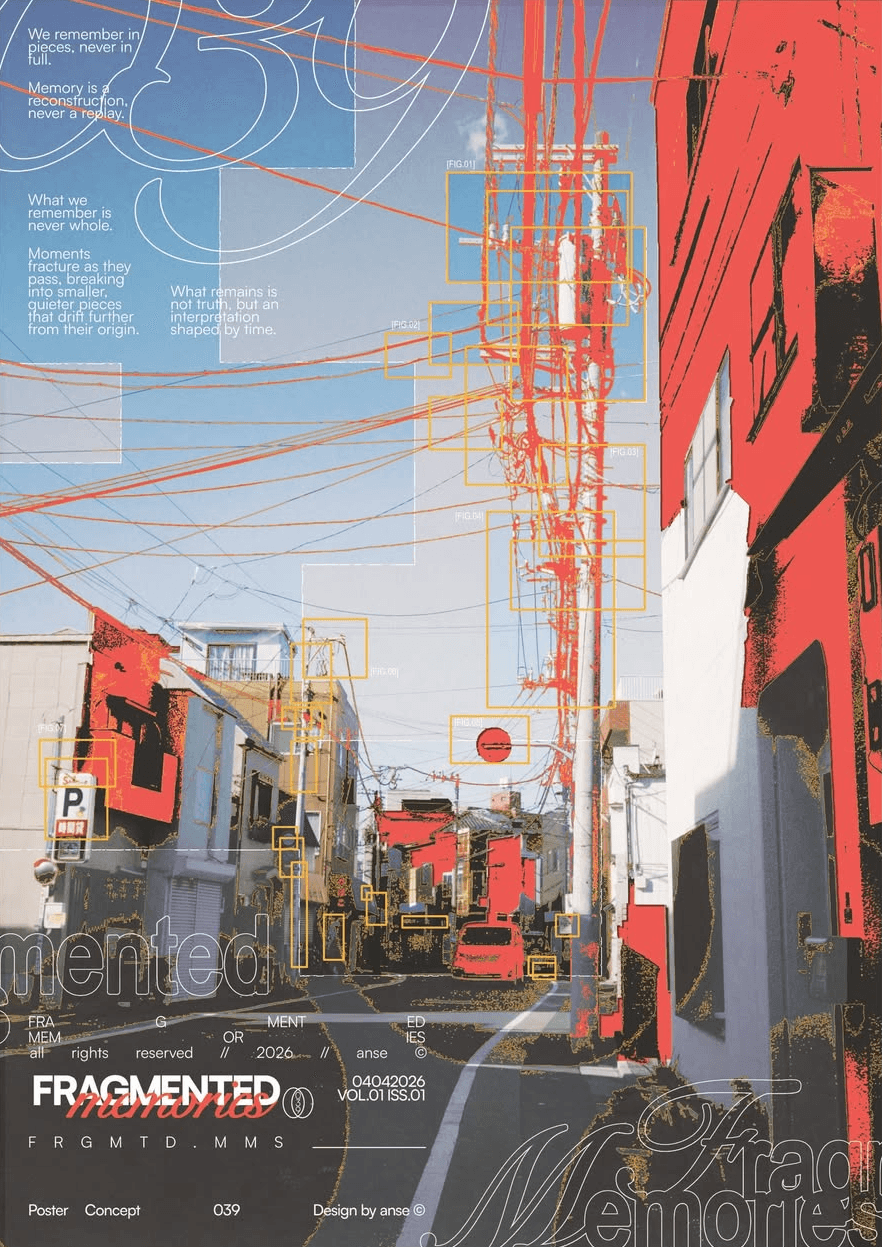
'Fragmented Memories pt. 1', 2026
What are you drawn to, and do you know why?
I’m drawn to the ephemeral and nostalgic behaviour of life, kind of like ‘memento mori’ or the passage of time. It’s part of the reason my style is very grunge, textural, and gritty. I believe this ‘analog’ feel to my designs reminds me of the past, before things became very digitised. I would think back to my younger childhood years and compare it to now; everything felt authentic and ‘unvarnished’, versus our fake personas in this digital age. So in a way, I find myself adding textural details to comment on the fleeting nature of time and memory.
What tools do you work with?
I started out using Adobe Photoshop and Illustrator to learn design because my school had its student discount plan. After I graduated I lost this privilege and searched endlessly for free design softwares. Affinity by Canva, was my perfect solution - it had almost all the tools from photoshop that I needed (i.e. its filter gallery, effects and layer control options). Outside of this software I just have my notebook and my phone to take images with. I learned all of the tools and software myself in my free time after school. Almost everyday I’d come home to plan out a poster design, watch youtube tutorials and record what I learned in a notebook with steps. This consistency developed my skill bank and familiarity with the software’s commands. At the same time, it sharpened my intuition when creating. For instance, if I had a certain effect I wanted to create, I would be able to quickly innovate and find ways to achieve it - solving problems right on the spot.
Walk us through your process on a piece, start to finish.
I always initiate with gathering inspiration online, scrolling for at most an hour on Pinterest for a basic framework of what I want to achieve. This step is crucial to me because it prevents you from wasting hours designing straight away and being unsatisfied with the result. I find that using references is critical to developing your own taste and help make strategic design choices. Next, I sketch many iterations of the layout on a notebook. Not only does this fuel my creativity by making constant adjustments, I also like the tactile feeling when most of my process will be digital. After I am confident with one of my sketches, I open Affinity and slowly layer elements. I follow a flexible and intuitive process where I may begin with positioning typography first, or play around with texture effects on my images and build from there.
Do you ever actually follow your own sketches?
Composition to me is more of an unorthodox experiment that happens simultaneously as I design. I don’t always stick to my original sketches as I proceed; I change things around on the spot when I feel like something could look better elsewhere or feel more powerful. My compositions can be described as an intuitive, subconscious process.
When does color enter a piece for you?
Colour is one of the last stages of my design. I feel that if I start using colour early on, it often hinders my decision making and disrupts my end goal. I like to keep my designs monochromatic at first. If there is a potential to use colour, I often add a gradient map over my finished work or highlight certain elements in a contrasting colour. This is something I want to improve on personally; I want to try using colour as a more purposeful intention within my pieces rather than an aesthetic. I know it can ignite certain emotions and appeal to human psychology, which is what I want to challenge myself with in the distant future.
What does typography mean in your work, if anything?
Typography in my work acts as a key part of my composition, drawing the viewer’s attention and maintaining their gaze as they navigate around the page. I use typography like the style of brutalists or swiss design - bold, distorted and haphazard arrangement of text. Although it looks randomly organised at first glance, I always follow a grid so there is some form of strategic placement and not solely intuition.
What does your process look like day to day?
My designs take multiple days to over a week to complete. Each day I would spend around 3 hours on average working on the design. Outside of this, I often take pictures of things during my daily tasks or whenever I go out. This is because I later turn these into textures/assets in software, or save them in my photo gallery for later use. I always observe my surroundings in hopes of adding to my design, whether that is advertisements, the ground, the lighting that bounces off a wall, anything to document and record.
How do you know when something is finished?
To be honest, I always feel like my work can constantly be improved on - which is kind of my pet peeve because I overthink things to the point of annoyance. I usually ‘finish’ something once I’ve overlaid so many layers of text, details and texture that any more would not add to the artwork visually and/or meaningfully.
Where do you start when a piece isn't working?
When I’m having an artist block I sometimes disobey my usual process of initial sketching. I have this urge to just put something on the canvas; First, I’d always go onto Pinterest to find inspiration. Once I’ve had a ‘light bulb’ moment or the slightest burst of an idea, I will open my software and just try laying things out. This could be opening an image from my personal gallery and playing around with its texture - experimenting and ultimately having a cool effect I could use it. Some occasions things still don’t work out; I spend hours playing around and in the end I might just scrap it all. Though, I’ve come to embrace this part as I feel it shows me what doesn’t work out and what I’m used to.
Where are the edges of your technical comfort zone right now?
I’m still learning how to make the most out of filters, effects and layer controls in my software. For instance, using blend modes to create unique overlays, or effects that create interesting patterns. So far I’ve only scratched the surface on its abilities. Additionally, I feel that my choice of colour palettes and combinations can be improved to be more harmonious. Although I love to experiment with typography and composition, I feel afraid to innovate with various colours and unique effects on images. This is something I aim to develop and hone the more I create.
What do you keep returning to?
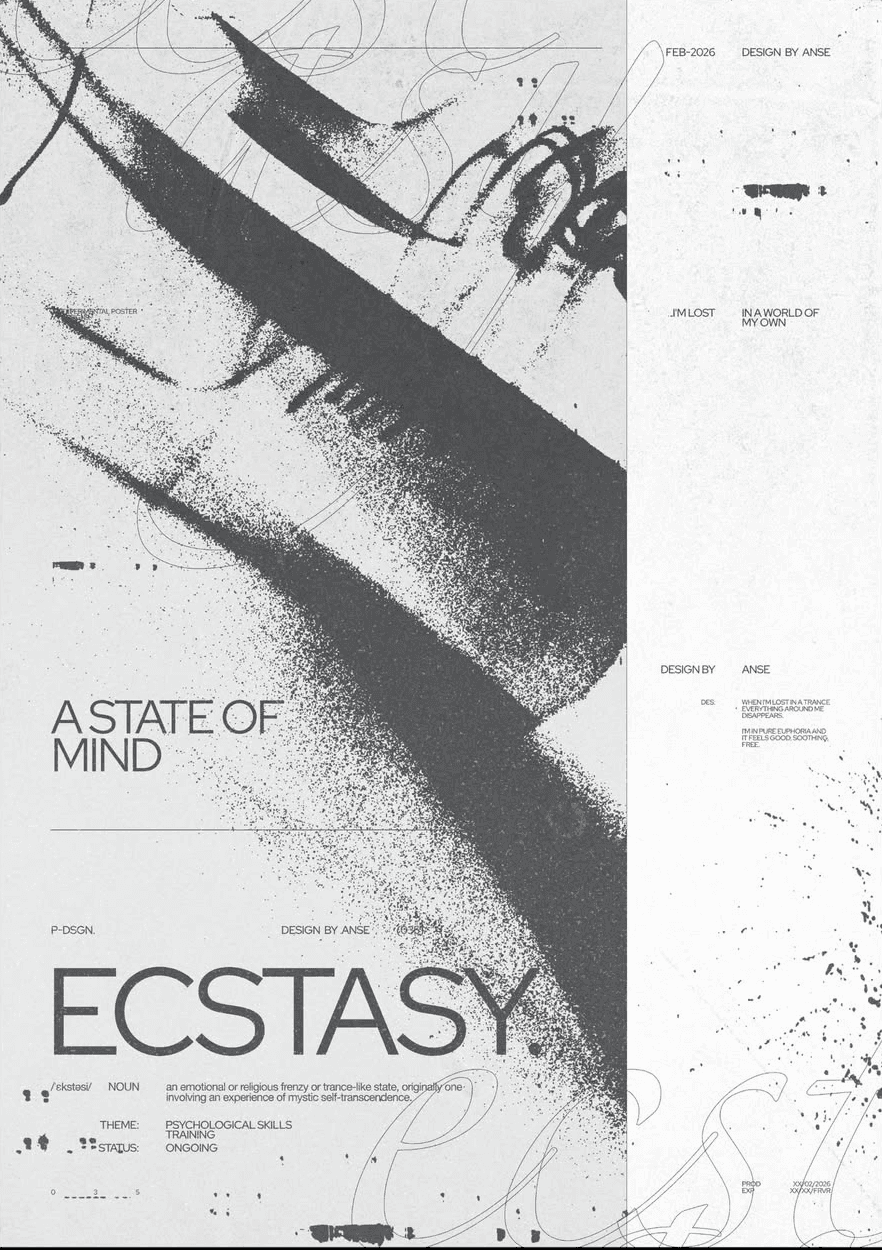
I believe I keep returning to the exploration of human psychology and emotion. For example, when I’m deciding a theme for my designs I see that a lot of the time it relates to the human mind. This can be seen in my ‘Saboteur Series’ that I did a year into my graphic design journey; I explored the inner mentality of humans that undermine our success, well-being and relationships (i.e. the hyper-achiever, the joker, the controller, the pleaser). My other instances include human boredom, ecstasy and childhood.
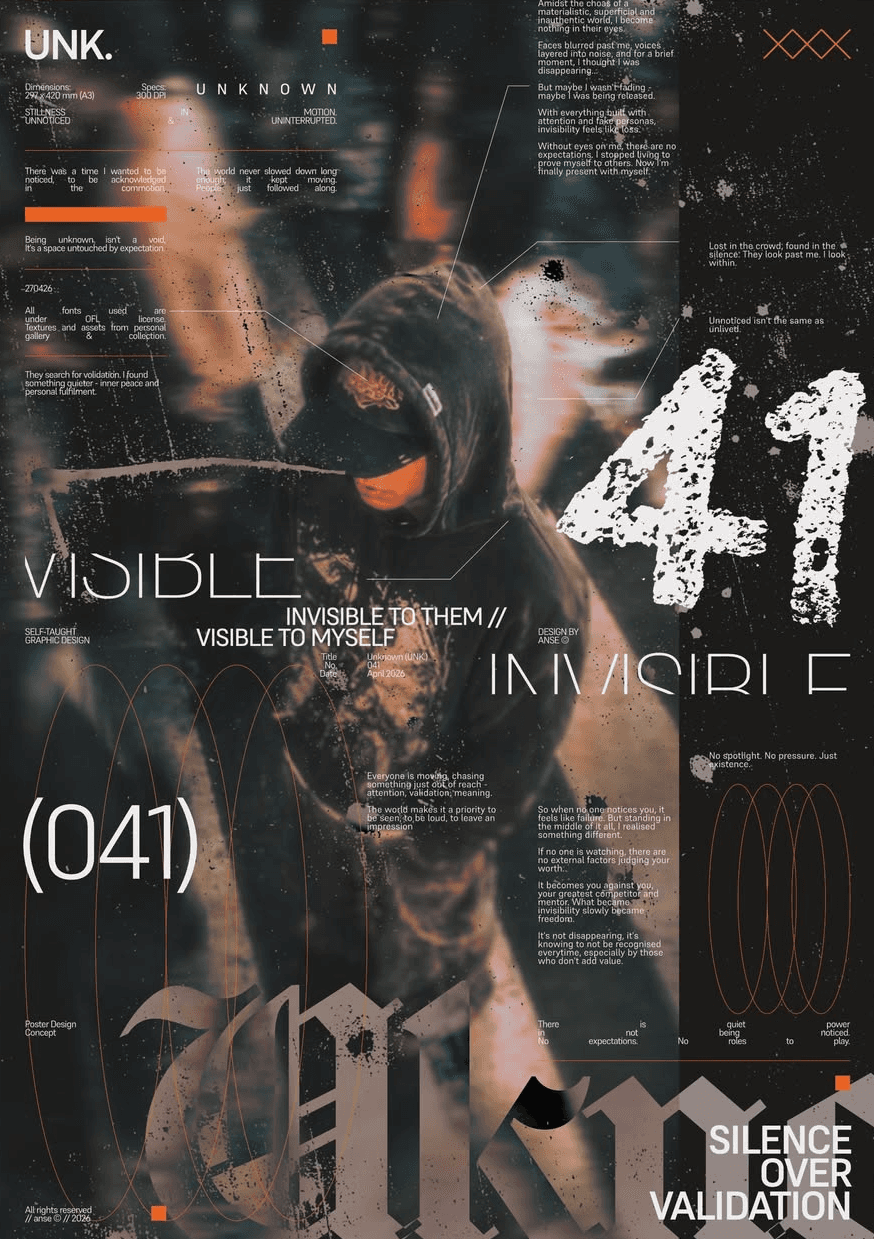
'041', 2026
What are you working against in your own work?
I find myself working against time and being able to design quality work without rushing. I have an urge to finish swiftly and uphold a high standard of one design a week. However, I find that this often limits my creativity and there are occasions where I just can’t see my designs being completed at a satisfactory level. Hence, I would leave the design and recreate a new one from scratch.
What tension are you most interested in right now?
Currently, I’m interested in the tension between order and chaos. My designs fluctuate between organized elements and experimental layout. Whilst I follow a grid when composing the design to keep it harmonious, I sometimes try to break this with my assets. I feel that it allows the audience to wander around the canvas and become curious. Of course, sometimes I like simplicity and believe that a piece doesn’t always need to be experimental, but rather have clarity and function. In other words, I try to play with organized chaos.
How much of what ends up in a piece was planned versus discovered mid-process?
I have to stress this: every time I begin a design, it will never look exactly like the initial sketches. The majority of my works are discovered mid-process. In fact, I dare say all of my designs derive from my planning but deviate as I develop it in the software. Once again, my process is very flexible and intuitive. Sometimes my planned composition looks a bit awkward and I try moving things around, which eventually feels better for the composition. I might also begin a piece with just text, then when it comes to adding an image, I shift things around to make it harmonious. I’ve begun to admire this part of my process, where I just trust my intuition and eventually find a way around things.
What does restraint look like in your work?
Sometimes I restrain myself by using one font in my work. Whilst this can still generate an aesthetically pleasing design, I feel that I could push myself further with typography. For example, being more experimental and blending serif with script font, or perhaps scanning in my own handwriting. Another restraint is that I mainly use my own photos from my personal collection. This can create flat and uninteresting designs that could be elevated with professional photography and subjects. So when this does happen, I lean towards royalty free images found on internet archives and websites. Otherwise, I do wish to become even more innovative in how I use my images.
Do you think your work has a message?
I haven’t thought much about what my work represents, I merely like to create whenever I’m inspired or when I want to make something aesthetic yet innovative. Perhaps this is the ‘message’ behind my work that I haven’t articulated yet - to be experimental, bold, unrestricted and innovative. To express your intrinsic thoughts and fleeting moments on a 2D canvas. I guess this is also why my compositions are quite chaotic and versatile, they illustrate my random ponders and ideas.
What would you make if no one was going to see it?
I believe I would be designing graphic posters if no one would be seeing it. Ever since I began my creative design journey, I often printed out my own posters to hang in my room. It reminds me of how I’ve developed over time and brings personality into my safe-zone.
What do you wish your work did that it doesn't yet?
I wish I could add 3D renders to my work - I see many creatives use these 3D, inflated, metallic chrome objects on top of their designs and typography. I think it extends graphic design beyond 2D layout into a sci-fi, futuristic style. I also wish to create analog poster designs - like how people would print out, cut, assemble and re-scan the piece back into the software; I also see designers stitching their own zines or printing on all kinds of materials. It’s very textural and adds tactility to a digital medium.
What are you actively trying to develop, in the work and beyond it?
In terms of my technical skill assets, web development / UI design is something I’ve been trying to get into, especially when graphic design can help branch onto this. For instance, I’m trying to learn Framer (a no-code web development tool) by following youtube tutorials. I’m also self-teaching myself Auto CAD design and product sketching - anything that relates to my future passion for industrial design. On the conceptual side of things, I want to improve the meaning and conceptual themes behind my designs. For example, maybe using more symbolism and motifs rather than relying on aesthetic layout and typography. Regarding my graphic design passion, I wish to grow my current skillset and design thinking to be more purposeful and artistic. In terms of growing my design passion into a career, I am still young and inexperienced about real-world industries. So, I am not as knowledgeable about my design passion being a permanent career or viable path. In this case, I would merely love to expand my portfolio during my studies and brainstorm pathways that allow my creativity.
What do you want to be doing in five years?
I hope to still be in the design field within the next five years - specifically industrial / product design. I’ve come to acknowledge that my inner passion is creative and experimental, and I want to curate this innate part of me. I also have an interest in business and entrepreneurship. Essentially, I would love to blend the two together as a career and study them at a higher level - such as a masters. But for now, I’m just trying to apply to these roles in university and see where it takes me.
At seventeen, Anse is already making work that feels older than it should, like it’s been handled, worn down, and remembered more than once. Her posters don’t present themselves cleanly, they resist you a little, asking you to sit with them instead of scroll past. That friction is the point. She’s not trying to clarify things, she’s trying to hold onto the moment before clarity, when something is still shifting and uncertain. The textures, the distortion, the density, it all builds toward that feeling of something slipping but not gone yet. It’s a way of working that trusts instinct over perfection, and process over outcome. There’s a kind of patience in that, even when her work is built quickly and intuitively. What she’s building isn’t just a look, it’s a perspective that treats design as something lived through rather than consumed. And if her work is about what fades, what’s clear is that she’s only getting started.
Articles
Magazine
Submissions