
Painting
Traditional Art
Portraiture

Isabel Lauren Loewe
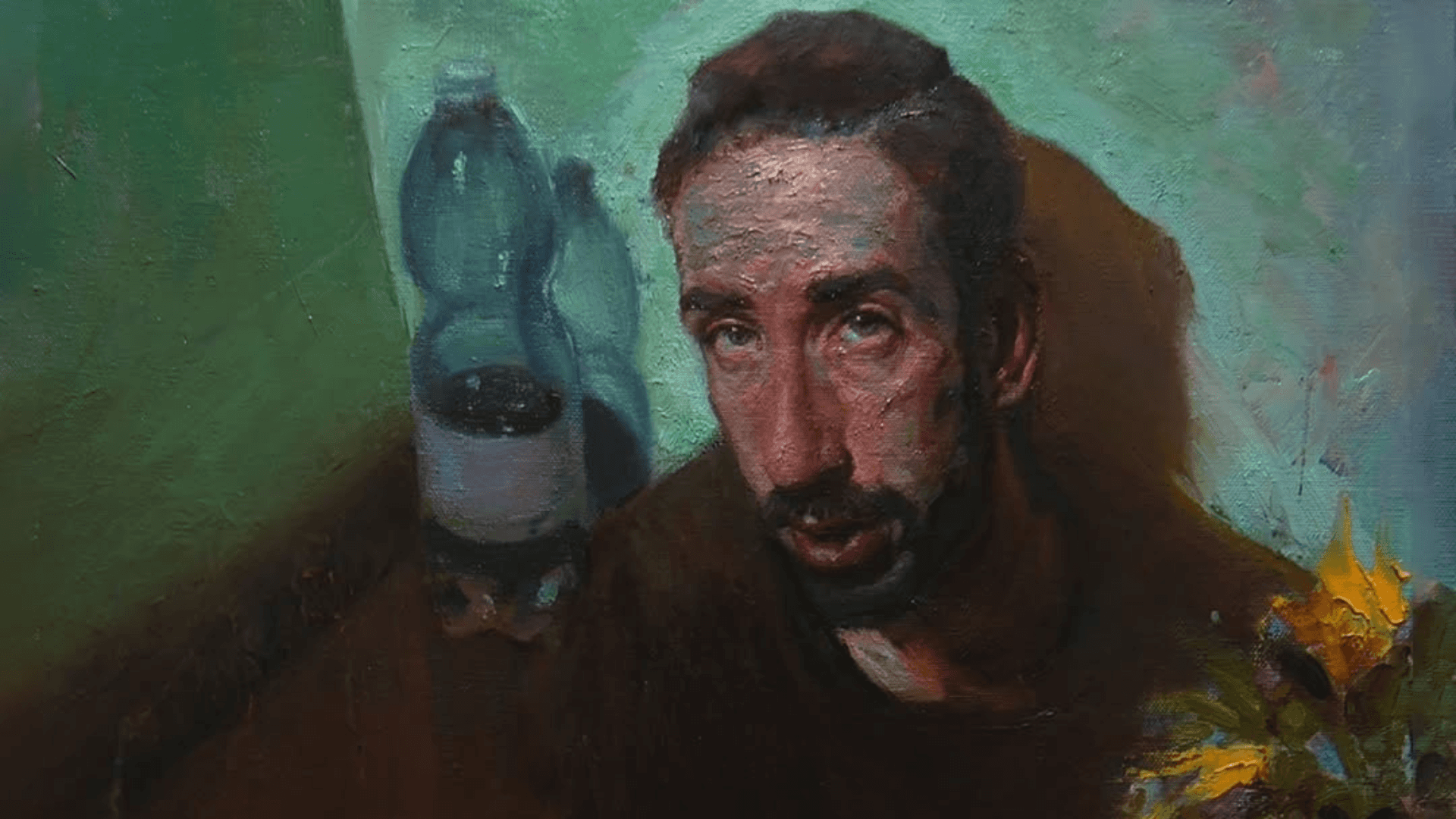
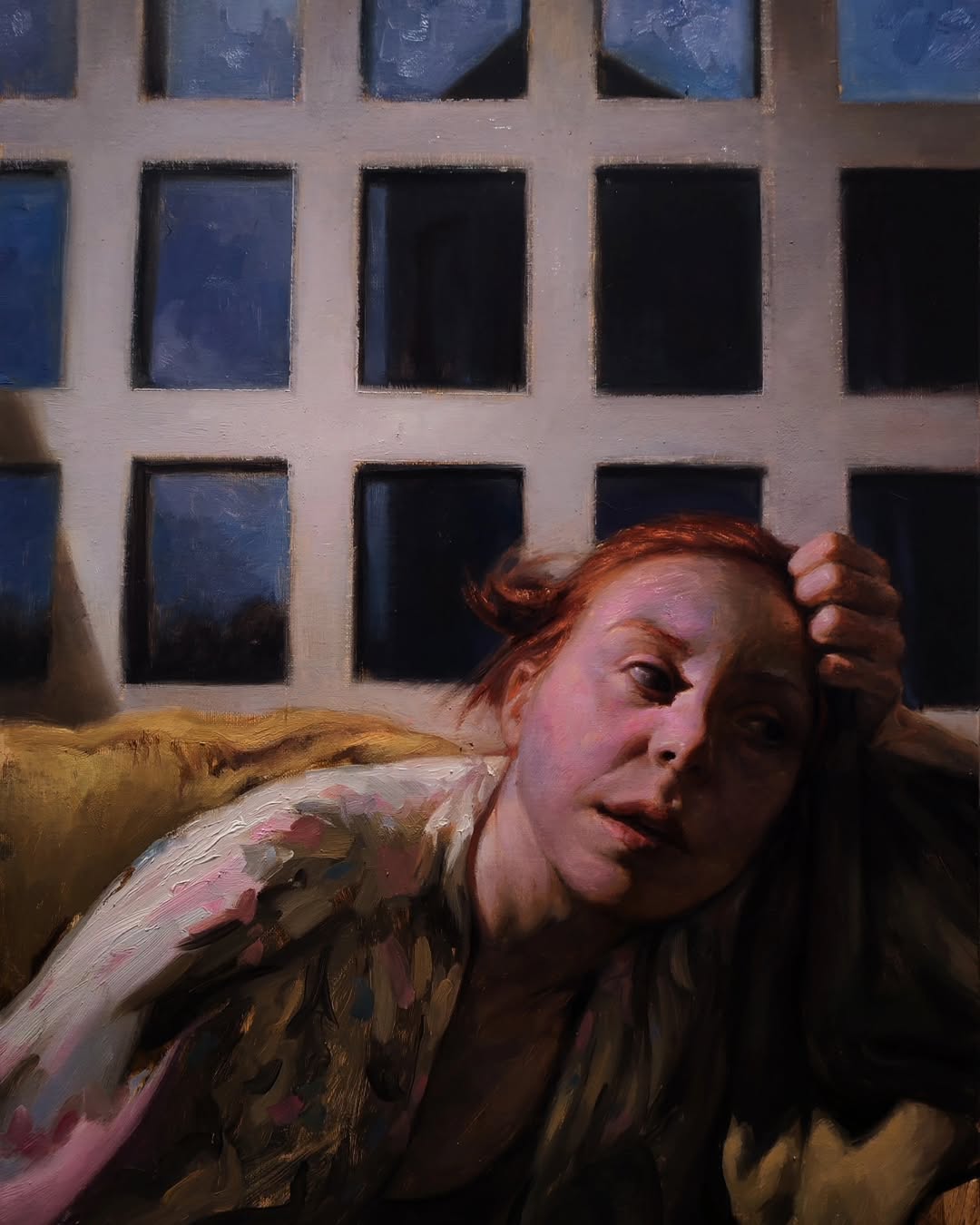
"Per accendere un tramonto", 2024
Marcos started with Photoshop as a teenager, making photomanipulations of cinematic landscapes he couldn't have photographed himself, and the further he pushed the tool the more he wanted to stop depending on it. By nineteen he was living in London, working at a restaurant, and developing what he describes as a need for actual paint. He moved back to Rome, enrolled in the Academy of Fine Arts, and spent six months there learning almost everything from a single fellow student named Michele before leaving the month after Michele told him there was nothing left to teach.
He has had a neutral-to-hostile relationship with the art market ever since he understood what it was asking of him. Painting, in his view, is not a profession but a way of surviving life, and whenever his work starts trying to accommodate the market, something dies in the paintings and he can feel it. He is currently working on a 3x2 meter commission involving seven figures, the largest piece he has ever made, and he will tell you that it still feels like the beginning.
There is also a series he has been thinking about almost every day for several years, one that he keeps finding creative ways to avoid because he knows what it will cost him when he finally starts. He is based in Rome, in the outskirts, not exactly where the postcard views are.
Where are you from originally, and how long have you been based in Rome?
I'm actually from Rome, in the outskirts, not exactly where the postcard views are. I lived a couple of years in London but most of my life has been spent around this area, between Rome and Fiumicino.
How did you first get into painting?
Back in my teen years there was this new software called Photoshop, the internet was only a few years old, forums were a thing, Wacom had released their first drawing tablets and I was so fascinated, creating photomanipulations of these cinematic, impossible landscapes. The more I made, the less I wanted to depend on photography and the more I relied on the brush tool, until I figured it was going to be easier to just learn how to paint.
When did oil become your primary medium?
Around 19, at the peak of my confusion about who, where and what I wanted to be. I was living in London, working at a restaurant, and slowly realizing the limits of digital art - the screens, the electricity, the lack of physicality - and I developed this need for actual paint, real brushes and tangible canvases. I moved back to Rome and enrolled at the Academy of Fine Arts at the last minute. To my biggest disappointment, I quickly realized none of the teachers could really paint or teach me how to, but there was one student who could: Michele. I stopped caring about exams and spent the following six months going there just to spend time with him and absorb whatever I could.
I had no idea what turp was, what an underpainting was, what a cadmium even looked like. Meeting him was crucial.
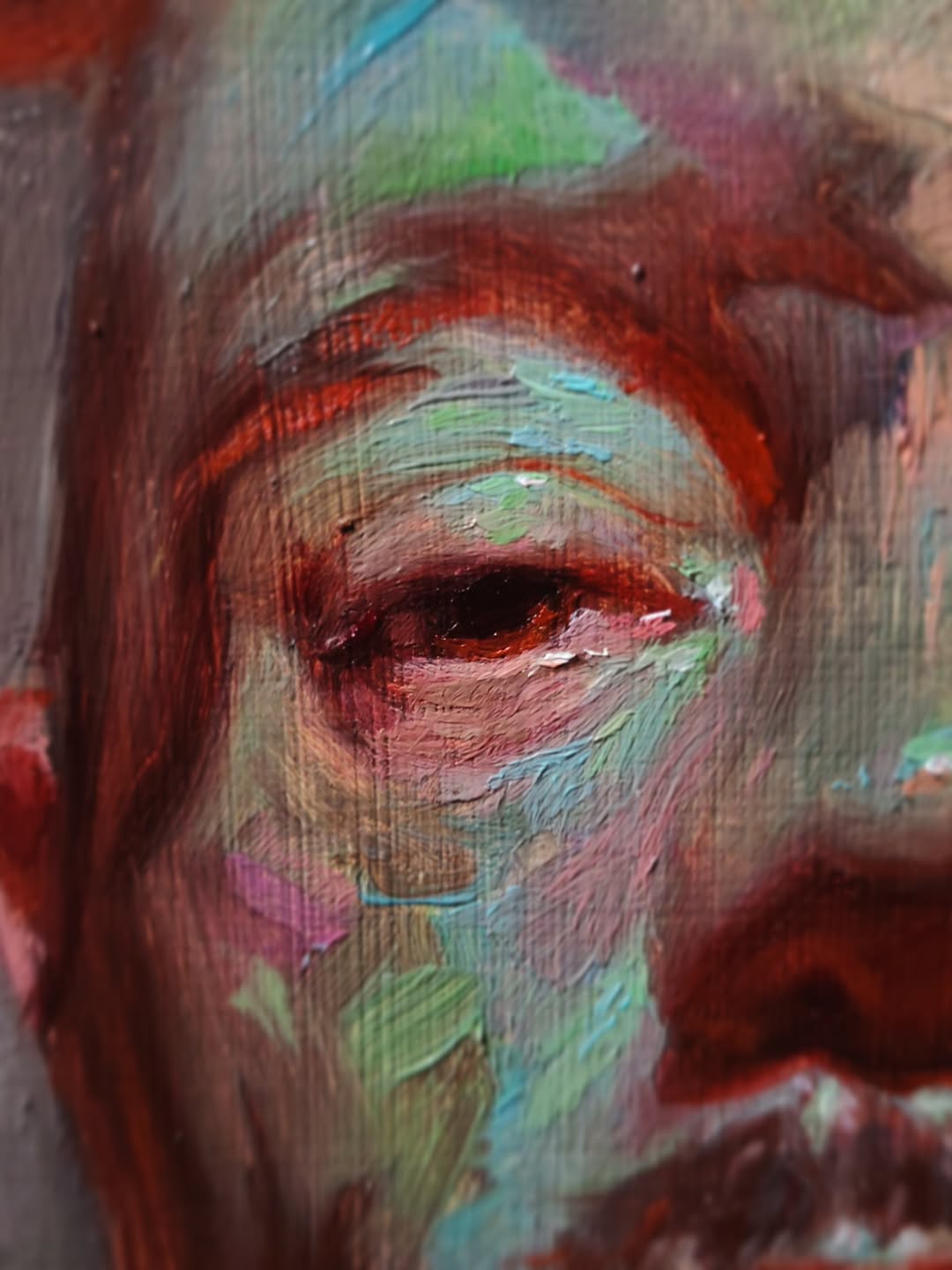
"No human is ever just one person", 2025
Were you formally trained, or largely self-taught?
That experience was probably the closest I ever got to formal training. One day Michele told me he had taught me everything he could, and from then on it was on me. I left the Academy the following month.
From there, it was books, videos, and practice. I gorged on every piece of knowledge I could find. I'll forever be grateful to the internet for that.
Rome is filled with ateliers and masterclasses in traditional painting. Have you sought out that kind of education?
Never, to be honest. The Academy of Fine Arts had been disappointing enough, and I couldn't afford the actually good classes. There was a deeper truth too, I think. I was already 1-2 years into my practicing years, and I stumbled onto the book that changed the whole game for me: Alla Prima, by Richard Schmid. Once I was done reading it, it felt like he had given me the tools, it was all there was to say, and from then on it was, once again, on me.
I wanted to find my own answers to the questions that painting was asking me, that book taught me how to ask the right ones, I had more than enough. Whatever answer I was looking for, it was encoded in reality and my ability to interpret it, never in someone.
How did you discover your style?
I see finding your own style like finding your own signature: it happens naturally once you've learned how to write proficiently, after years of repetition. It's something not worth worrying about.
How would you describe your work to someone who has never seen it?
I'm not very good at talking about my work. I make figurative paintings, mostly focused on the human being, and through the qualities of painting I try to express things that are often difficult to put into words, which is why I'm not very good at talking about my work. Then I show them.
Your color choices are striking, particularly the way you push non-naturalistic hues into skin. How do you think about color in relation to realism?
I mostly don't. I think very carefully of temperature, but color has not too much of a voice when it comes to realism. It matters a lot in how I communicate visually - sometimes color is words, everything else is grammar. I care very much about greys, though. They do most of the work, which allows me to easily push chroma up when I want to say "hey, this part means something, look at it". Color is where I feel less constricted, free, it's the improvised solo parts in my little songs, and it's 100% the element that got me into painting, the one I truly obsess about. Value, shapes and edges exist for every living being equipped with light receptors, but color as we see it is a unique human experience, rooted in symbolism, emotions and psychology. It's millions of years of evolution and lots of unknown answers. How cool is that?
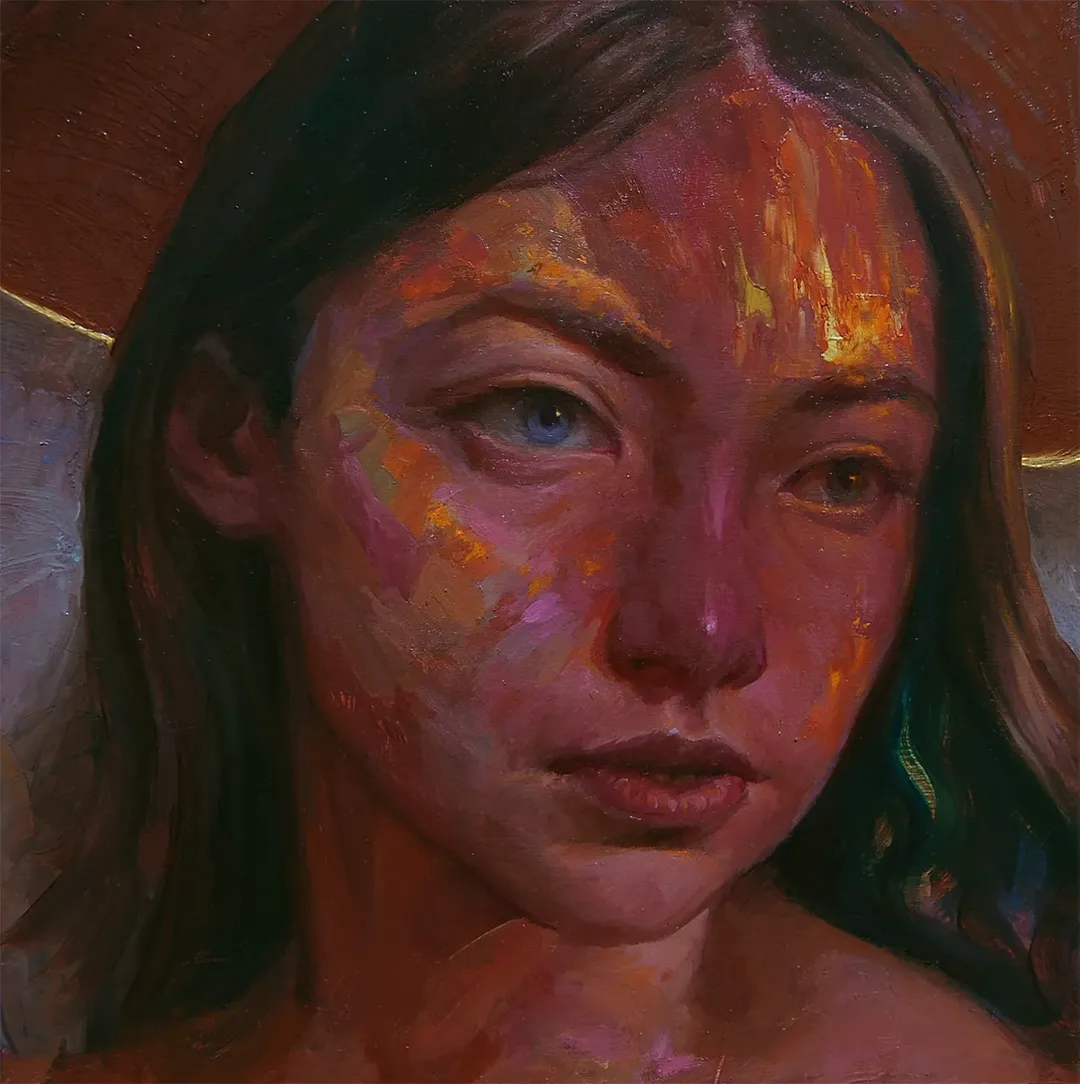
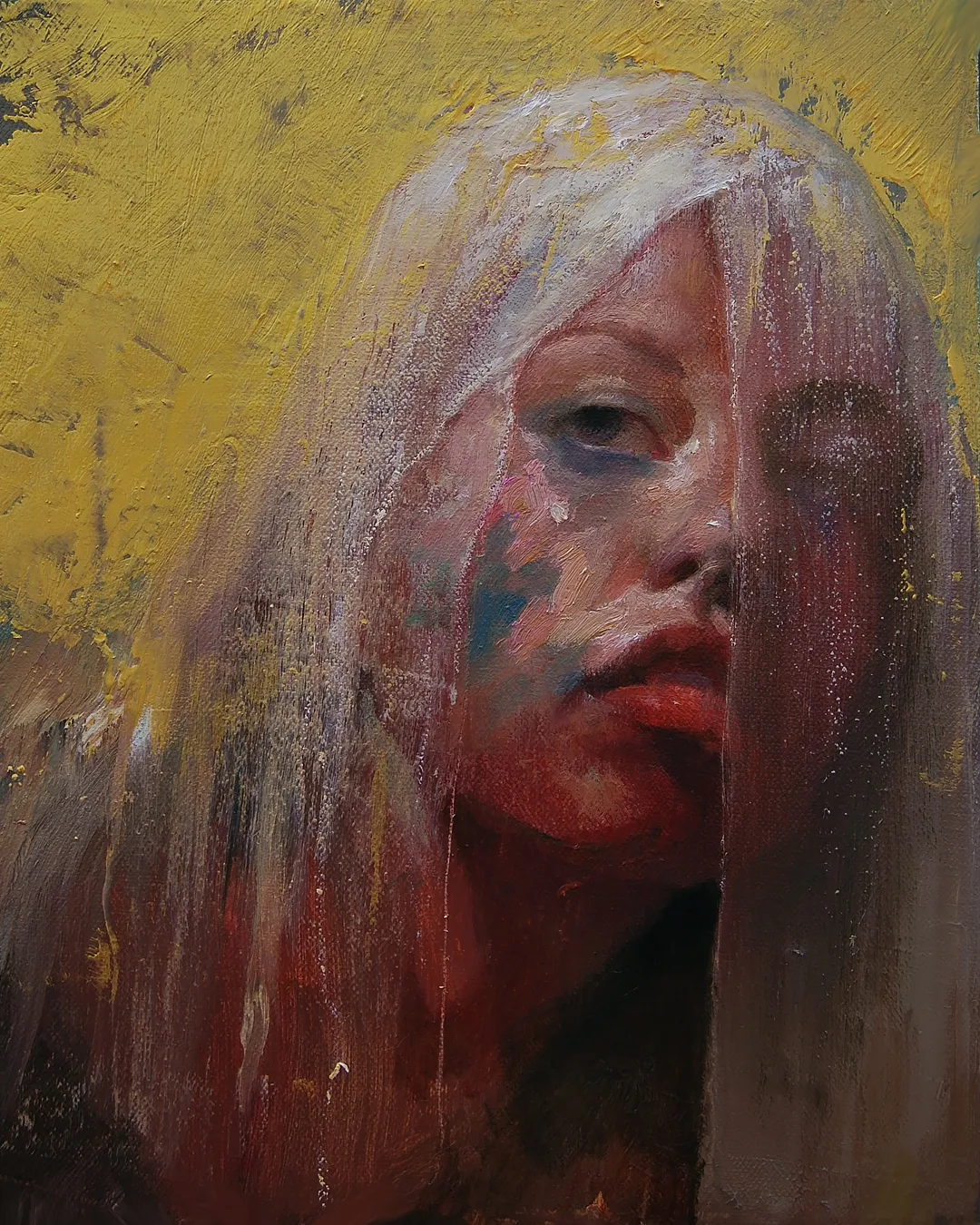
"Un diavolo niveo", 2024
How did you master your value control?
A lot of people approach value through structured exercises. Black and white studies, academic drills - and I did some of that, too. But I always felt that my urge to create was stronger than my will to become technically good. So instead, I kept painting what genuinely interested me, and through each new work, I was unconsciously training my eye.
I think there's an advantage to that approach: it stops feeling like practice and becomes exploration. It's no longer about doing things "correctly." It's experimenting and pushing outside of the boundaries, to put oneself in uncomfortable positions and then figuring the way out. This approach won't make you the best technical painter of the world, but an interesting one for sure. Painting has never been about technique anyway.
Do you use a straightforward dark-to-light method, or do you build layers all at once?
I usually work from mid-tones outward, mid-to-dark and mid-to-light. My goal is to use as few values as possible initially, so I can preserve my darkest darks and lightest lights as final weapons, if needed.
Do you use any photo software to alter a reference before painting it?
Yes, Photoshop. I've used it since the beginning, and it remains a fundamental part of my process, especially for more complex works. I use it for sketches, compositional testing, color adjustments, and problem-solving before paint even touches canvas.
Walk us through what a sitting or reference session looks like for you. How much time do you spend with a subject before you start painting?
The more, the better. When I portray someone I try to portray the person and not the body, the shell. That requires time from both sides: time for me to see beneath, and time for the sitter to feel safe enough to reveal something real. Sometimes it happens in a matter of hours, sometimes it takes much more, or it just doesn't work at all. We talk, and I shoot photographs, as we talk. I take lots of them, the first few hundred are just for the sitter to get used to and forget about the camera. If we're lucky our chat will land on a sensitive area, something that means a lot to the model, and that's when I can catch the best moments. A sigh, a look of regret, a laugh. Something real. It doesn't happen very often, but when it does it's nice.
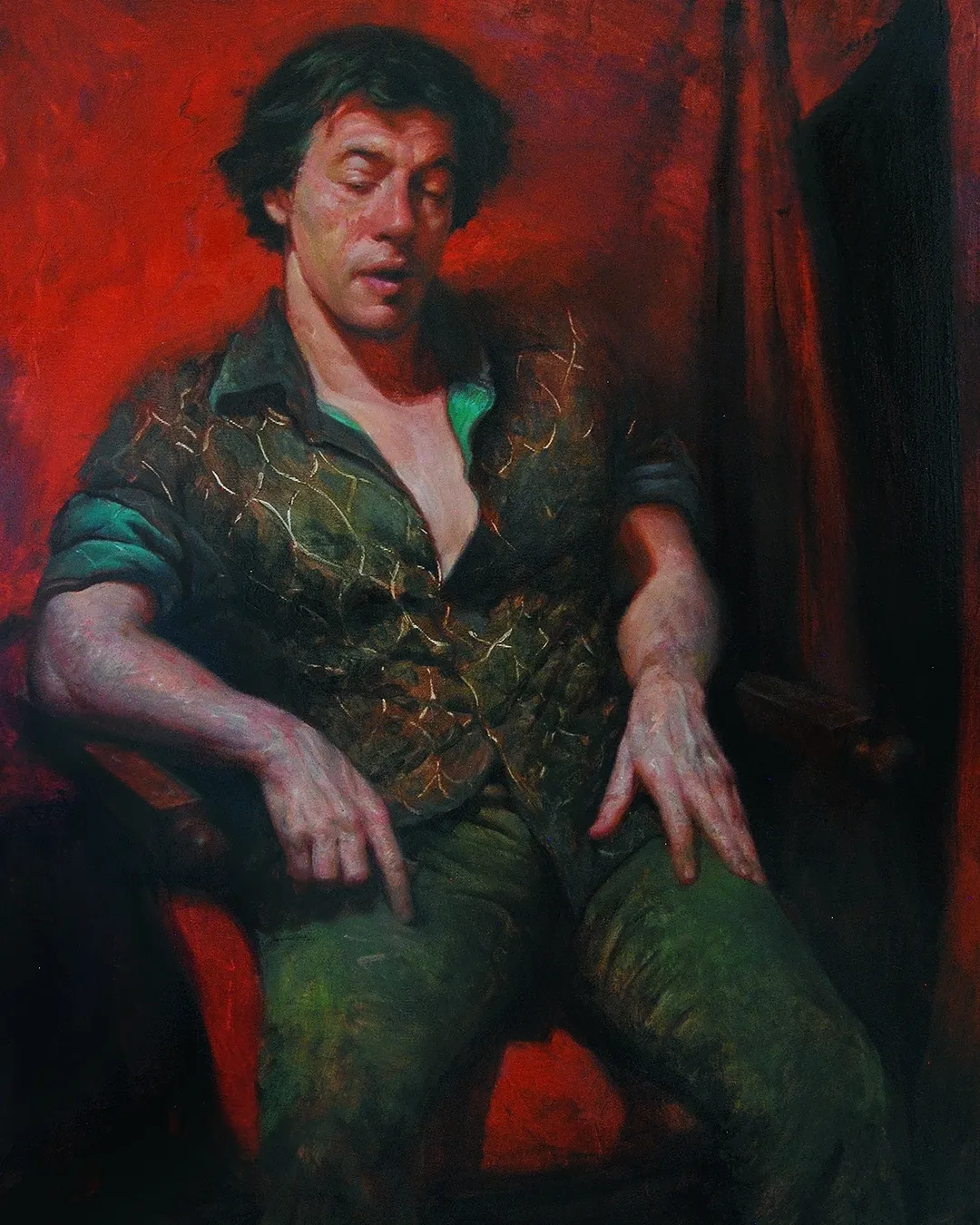
Your caption for "Il comico" described meeting Filippo Preafico after a show and asking if he wanted to be painted. How often do you approach strangers that way?
Not very often, I only do it when it feels meaningful, when someone leaves me with the sense that there's something worth exploring. With Filippo the connection was almost immediate, it's definitely one of my favorite paintings because of that. There are hidden things in that painting that maybe just me and Filippo will ever be able to see, we both know what we were talking about as I shot that specific reference, and this to me adds layers to it, invisible to most people, but they are there.
What draws you to a particular face or figure as a subject?
It's rarely about physical appearance alone, it's about character. There's something intangible in certain people, something that suggests depth, contradiction, or truth. Recognition isn't easy, and more often than not, I get it wrong, but when it works it's magic.
Do you prefer portraiture alone, or do you have figurative ambitions beyond it?
My larger goal has always been narrative, multi-figure painting. Portraiture has been, in many ways, my training ground. Every painting I've made has been a step toward larger, more complex works.
Over the past year, I've been working on a 3x2 meter commission involving seven figures. The largest and most ambitious piece I've created so far. That's where I want to go. And honestly, it feels like I'm only at the beginning. I'm so curious about what I'll be painting twenty years from now.
Several of your titles carry a literary or philosophical weight. "No human is ever just one person." "Not a lot, just forever." Where do those come from?
Sometimes if I can't paint I write, and sometimes but rarely I get something worthwhile, but most of them come from songs or books or other people's ideas, pieces of art or knowledge I felt connected to as I was working on the painting. I like the idea that for someone curious enough to explore a painting further, even a simple Google search might lead them toward more art, more thought, more connection. I don't see my paintings as something I own but part of something bigger. It's not mine. I'm just filtering the world, a lung, oxygen in, carbon dioxide out.
How much do you know about a painting before you start it, and how much reveals itself in the process?
When I start I think I know enough about it, I think I know where it's going and how it's going to look, I try to get my ideas straight - but most of the time I'm wrong. I underestimated certain things, overvalued others. But being open about it, being able to carry a conversation with the canvas, to listen and to reply, to act like a decent human being, usually leads to solid results. Not to be perfect, but honest.
Does your work usually come out how you saw it in your head?
It can and it does if it needs to, but that's not where I'm trying to go with my personal work: I paint because I genuinely enjoy the process and its problem solving nature. It has to surprise me, challenge me, entertain me. I want discovery. I look for balance between planning and painting successfully, and creating a nightmare for myself.
You mentioned that finishing a small painting within hours felt strangely liberating compared to working for months. What does scale do to your relationship with a piece?
I have a very obsession-driven mind, once I begin a painting, it becomes psychologically consuming. I don't really "clock out" from it. So carrying a large work for months can feel both deeply fulfilling and, at times, like a kind of curse. I love that intensity, don't get me wrong, but it can be exhausting.
What is the hardest part of a painting for you?
Probably it's translating something deep and complex into something that feels honest, clear. It's really hard to make something worth stopping our fast, hollow lives for, right now. Balancing depth with clarity, without overcomplicating or losing authenticity, is often a challenge for me, and I usually feel I miss my shots. I still try, though.
How do you know when a painting is finished?
There's usually a point where every new brushstroke starts to feel redundant. If it seems like I'm repeating something that's been said before without adding anything meaningful, that's when I (should) stop.
You have shown work in Paris with the Cane Yo collective and in Berlin. What has the experience of exhibiting been like for your practice?
Incredible. Apart from the amazing art I've got the chance to be surrounded by, which is by itself a great experience - my relationship with the collective started many years ago, it gave me confidence and a chance to interact with other painters, and at the time it meant, and it still does today, everything. Painting is a very solitary experience, it's hard to get to meet in everyday life someone who can understand what we go through. Showing with them means being surrounded by your people, and it's so very special. We come from all over the world, different cultures and languages, different backgrounds, and yet the connection is so strong and powerful. You know for certain you belong to Earth, and no other nation.
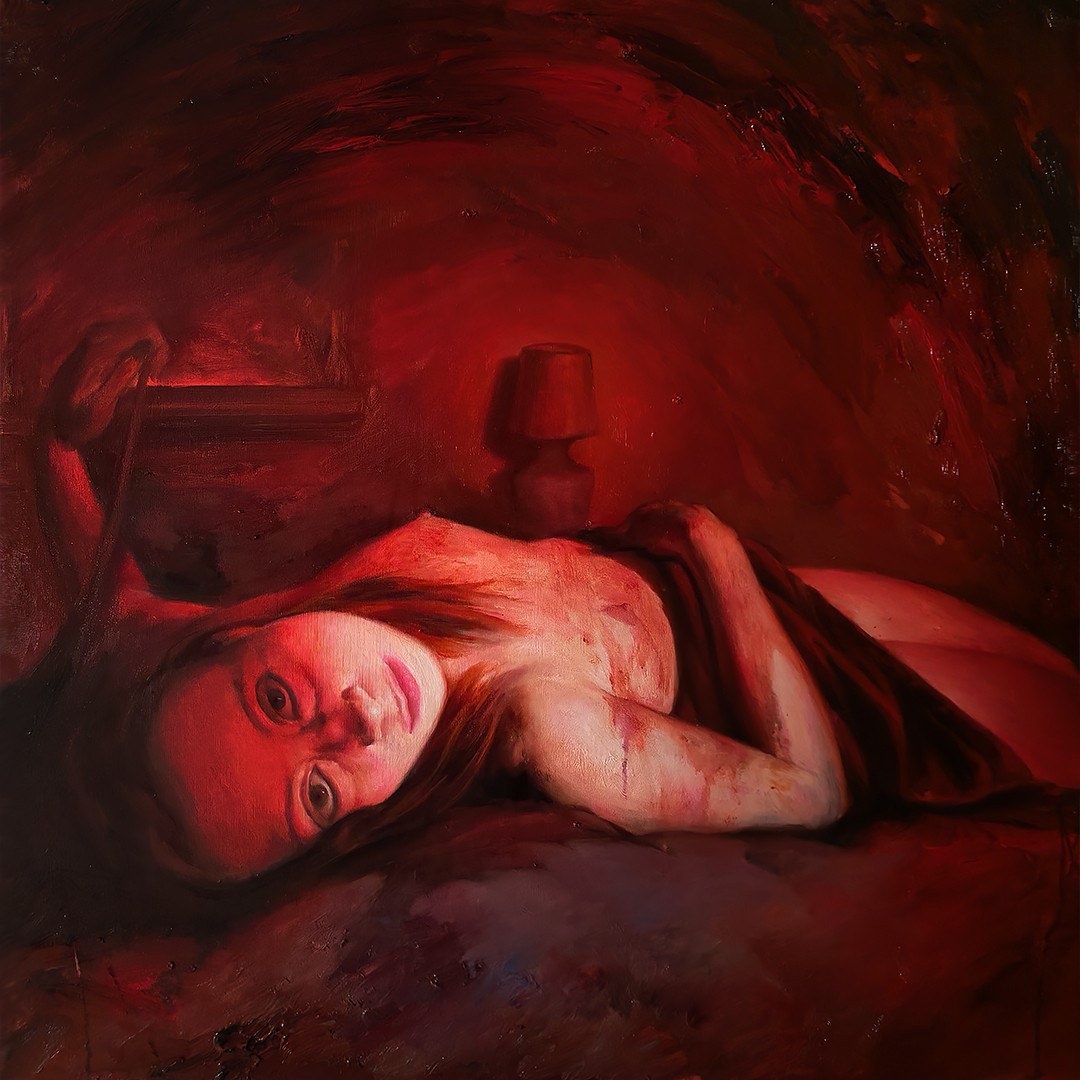
"Amnesiac", 2025
How do you think about the relationship between painting for yourself and painting for an audience or a market?
I fell in love with painting because it was my language. Not words, images. And it felt more natural to express myself that way, more true to the way I experienced things, it started becoming a necessity, if I don't paint personal art for too long I get depressed, disconnected. I love the idea of an audience, I'm an art consumer before being a creator, I'm part of many, many people's audience, and I know how vital their role has been in my life and I want to give it back and be part of that - to be a drop, together, in the big wave.
The market is probably my weakest point. I have a neutral-to-hostile relationship with it. Whenever my work starts trying to accommodate it, something dies and the paintings become weaker, and it takes a huge amount of energy to push them through to the end. I firmly believe painting isn't a profession, but a way of surviving life. It's not a job, which is why painters don't really retire, and paint until the day they die. And yet, if we want to paint full-time, we have to confront the late-capitalist market and compromise, sell out, adapt, whatever you want to call it, and survive. That tension has probably been the biggest challenge of my life.
Do you work on multiple pieces at once, or one at a time?
One at a time, I couldn't work on multiple things at once. When I "step out" of whatever painting that painting is evoking, it's really hard to get back into it.
What does your studio space look like, and how does it shape how you work?
I got used to studio spaces you wouldn't call studio spaces, corners at best, and the en plein air experience teaches you painting is where the paint is. Right now I'm painting in a landed space for the duration of the creation of the large commission I'm on, it's the best studio I've ever painted in but it's just a big room and there's not much in it apart from a tool cart I converted into a huge palette, a ladder and a few studio lights. I don't think it shapes it in any way, it just changes how comfortable, or frustrated, I might get as I work.
Are there painters, historical or contemporary, whose work you return to regularly?
So many. A few off the top of my head but trust me I could keep going for days: Rembrandt, Velázquez, Antonio Mancini, Dean Cornwell, Phil Hale, Olga Boznańska, Odd Nerdrum, Vincent Desiderio, Alex Kanevsky, Zoey Frank, Giorgos Rorris, Sean Cheetham, Keita Morimoto, Andrew Hem, Nicolas Uribe, João Ruas, Jeff Simpson, Paco Lafarga, Golucho, James Jean.
Do you think studying the Old Masters is necessary for a painter working today?
Absolutely. At least to the point where one understands that art is a millennia-old discourse humanity has been carrying forward through time, and that every attempt ever made - a painting, a poem, a photograph - is adding a thought, a word, an idea to that conversation. Every time someone stands in front of a blank canvas, they are entering that discourse, willingly or not. And I think that if you want to contribute meaningfully, you first have to listen before you speak. Studying the Old Masters isn't about imitating them, but about understanding their thoughts and the conversation they were carrying and that you are stepping into each time you try to make art.
You post-process videos alongside finished work. How do you think about sharing work in progress publicly?
I'm not particularly fond of making videos, they're distracting and time-consuming, but I do love sharing the process. It's full of moments where the painting feels one brushstroke away from collapsing, and I think there's something valuable in that uncertainty. The process makes sense to me, but I can imagine some academically trained artists looking at it in horror. Yet it proves something worth noticing: figurative painting is ultimately just fundamentals and problem solving. As long as you can recognize and work through the problems you encounter without panicking, you'll be fine.
What advice would you give an introductory painter that you wish you had?
This will be a long journey. Practice patience, it'll be the most essential skill. Be ready to sacrifice things, painting tends to take priority over almost everything else. It'll demand a lot from you, but it also gives back in ways you couldn't have imagined. Draw a lot. Painting is just drawing with a brush. Fall in love with the process, not the results. Develop a strong technique, but remember that it's one of the ingredients of a much more complex soup. And most importantly: trust yourself. Nobody really knows what they're doing. We're all just trying to figure it out as we go.
Is there a piece you have made that you consider a turning point?
No, not yet.
Technically, there's one but I can't remember which one exactly. I clearly remember that I was mid-painting, I went to sleep, woke up the next morning and started working on it again as any day - and it finally made sense. The paint, the drying times throughout the hours, the minutes, what mixing colors actually meant, which sequence of brushes made the most sense to use. There finally was a sense of control and it was no longer a fight with the canvas but more of a clumsy dance. It's still the hardest thing I've ever done, am still doing, and will likely ever do, but it starts to be truly fun after a while, in a way nothing else can be.
Is there a subject or format you have not painted yet that you think about often?
Yes. I've been thinking about it almost every day for the past few years. It's a series of paintings about a place and its people, it's where I grew up. It's probably where everything was always meant to lead me as a painter, there's just so much there emotionally, visually and psychologically.
But it's also one of those things I keep pushing away because I know it's going to be hard and it's going to consume me and mean more to me than anything else I've painted so far and so I keep finding creative ways to avoid it. I'll do it, though.
What is the most ambitious project you could imagine taking on?
A film. In my wildest dreams, having the resources and freedom to direct a movie would be one of the highest forms of artistic ambition I could imagine.
What do you want someone to sit with after seeing one of your paintings?
I don't know if I'm trying to leave people with one specific feeling, it probably changes from painting to painting. I think art is something we, as a species, don't really consider essential most of the time. It's not food, it's not survival, that's what I mean. And yet, in certain moments of our lives, art becomes almost vital. A painting, a song, a poem, a movie, a book. Whenever we're going through something, whether it's suffering or joy, that's often where we go when we need to feel understood, or just to feel something deeply. So I guess I'd want people to sit with that.
What does painting mean to you, outside of what it produces?
The best I've got out of life came through painting. Nothing else compares. I've been doing this for more than half of my life now, I've given so much of myself to it, and yet I'm certain I'll forever owe it and never be up to par. Painting gave me meaning, direction and reason to wake up each morning. It made me a better person and pulled me away from wherever I was heading before art became real to me.
Above all, it gave me something extraordinary to do, regardless of what else was happening in life. There was always this thing to return to. There always will be.
Articles
Magazine
Submissions