
3D
Art Toy
3D Printing

Isabel Lauren Loewe

'Imperial Dragon', 2026
Spicy Plastic looks like a toy line from a world where shrines, memes, dragons, planters, and old symbols all belong on the same shelf. Nacho Ruiz describes it as “adult Fisher-Price,” which feels close to the truth of the work. The colors are bright enough to feel playful, but the objects often carry something older, stranger, and more ritualistic beneath the surface. A skull becomes a planter. A dragon becomes a downloadable collectible. A mythological shape gets translated into plastic, then softened by the language of childhood.
That mixture comes from Nacho’s background in industrial design. He thinks like a designer even when the work behaves like a sculpture. Each piece has to communicate, print correctly, assemble cleanly, and still feel alive as an object. He is drawn to the space between art and engineering, where a form can be expressive while also solving the quiet technical problems of material, tolerance, color, and function. The final object may look simple and playful, but that simplicity depends on a long chain of decisions made before the printer ever starts.
The magic of Spicy Plastic is that the work does not stop in Nacho’s studio. He can design a piece in Argentina, publish the file, and watch someone on the other side of the world print it into their own hands. That possibility changed what he could make and how quickly he could move. After years of running larger 3D printing projects, he returned to a smaller setup with a computer, a printer, and the freedom to keep designing.

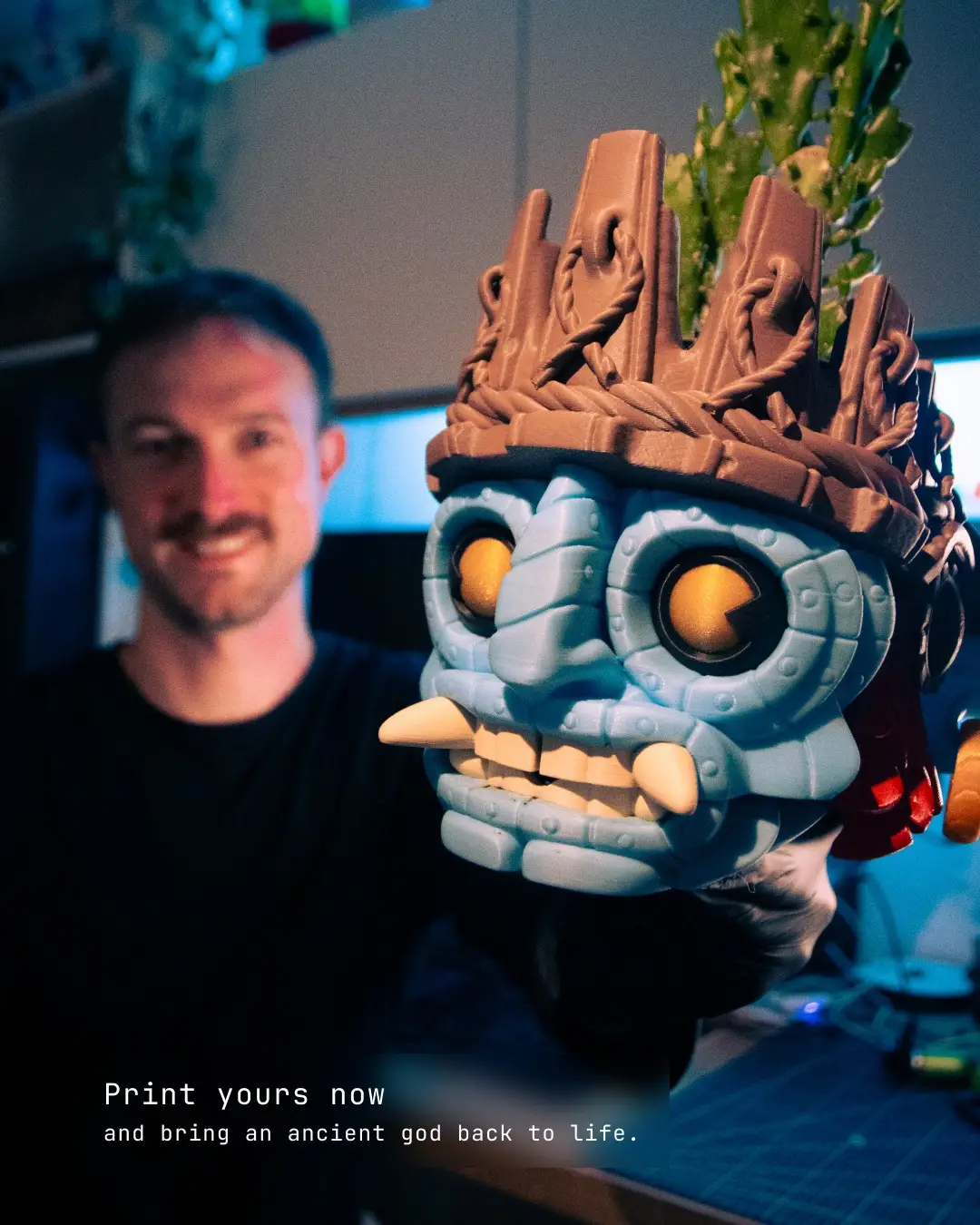
'Tláloc the God of Rain', 2026
Who are you?
It’s a difficult question to answer, but I studied industrial design, so I always thought of myself as a designer. I always had this problem-focused approach to things, but in the last months and years, I had this internal artistic voice that started to come out. I’m trying to find out what that statement is. It’s an ongoing process of finding out exactly what I want to do or tell.
This project, Spicy Plastic, is the manifestation of exactly that. It’s a project that has no strict definition or strict plan on what it will become. It’s more like a playground where I can just do the stuff that I want to do at the moment and publish it, and have an audience that’s waiting for that. I find it lovely, really, having that liberty and no plan at all.
How does your industrial design background affect the sculptures you make through Spicy Plastic?
What I do, and the sculptures that I’m making and publishing on this project, are really affected by industrial design. Not all of them, but some have a very product design approach.
There is this duality between the artistry of having a work that communicates something, and on the other hand, having it work and function for some specific problem or functionality.
How did you get into 3D printing?
While I was studying industrial design, 3D printers were just coming up, and I really became fascinated with the tool. Having the ability to design something on the computer, in this digital world, and a couple of hours later having it materialized in my hand was magic to me.
I got my hands on my first 3D printer, and that hasn’t stopped since now. It’s been like 10 years of having the tool beside me, and obviously my work has evolved with the tool in mind. It’s not only having the thing in your hand, but what it enables us designers to do is really magical.
Previously, you couldn’t have your products in your hand without having to talk to a company or manufacturer. Now you have the liberty to just press play, and in a couple of hours, see it in your hand or on your desk. It’s just magical.
Now with this web of files and marketplaces, having the ability to design something, and not only you having it in your hand, but anyone on Earth printing it and having it for themselves, is an opportunity that for me is mind-blowing. Me being in Argentina, which is a country that is far away from maybe the center of the world, so to speak, having that barrier taken down is awesome.
Do you have your own 3D printer now?
Yes. I have my computer and my 3D printer next to each other, and that’s my whole studio. I’m keeping things small on purpose also. I had the experience of having a print farm with an art business and everything, and after that not working out, I’m back to having just the minimal tools and being more free with the work I can do.
How would you describe what you do to someone who maybe hasn’t seen you on social media?
I’d like to say I’m building the wildest catalog on the internet for 3D printers. I really like icons of mythology, but also of the internet, and I’m trying to bring all those icons into one cohesive world of collectibles and products, and put that out there for people to be able to download and have in their homes and play with. To be a part of that work.
What got you interested in 3D modeling?
I think I always had this duality in me. I have a very artistic side and another very analytic side. I always liked to draw when I was a kid, and I also liked doing math problems at school. So when I had to decide what I wanted to study, I was kind of lost because I thought I would lose one of those sides of me.
When I learned about industrial design, something clicked there, and I said, “Hey, this is a middle ground between these two worlds.” 3D modeling is like the materialization of that. You sit down and you have to try to bring your artistic vision to some reality, but that later has to be printable and ready for production. So you have constraints and limits, and things you can and can’t do.
That conversation between the art and the engineering is something that I love. That game between those two worlds.
Do you feel like Spicy Plastic is the happy medium between your analytical side and your artistic side?
Yes. I think after several failed projects, or I don’t know if failed, but projects that had to end, now I found myself with Spicy Plastic in a perfect middle ground. I’m able to do exactly what I like, but I also have to make it work. I have to be conscious about the decisions I make. What is the next product? Why?
Sometimes I talk about them as products, and sometimes as works of art, depending on which side I’m analyzing. But I’m really happy with what this project is giving me as a playground to toy around with.
What kinds of projects were you doing before Spicy Plastic?
I did several things. One of my first works was that I bought a couple of 3D printers with some friends, and I offered the service of 3D printing to others. After some time, I realized that’s not what I wanted to do. I was giving service and just running a print farm.
So we designed our own products. That worked for a while, but I found out that the whole structure that you have to set up around having a manufacturing facility, people working there, teams, and all that, wasn’t what I wanted either.
What I wanted was having more time to design. That previous project went on for like five years, and I wasn’t designing anymore at the end of the project. So I sat down and said, “Hey, I’m not doing the thing I love. To be able to design things I love, I’m not having the time to do it.” So that had to finish.
With this, I found an opportunity to publish things and not be responsible for manufacturing them, but still have people able to print them and have them in their hands. It’s kind of the best of every world. I get to do what I do best and what I like doing, but the designs get in the hands of people nonetheless. I don’t have to take care of running a whole structure and big business behind me.
It’s like a new model for me. I’ve been doing Spicy Plastic for six months, which is not a long time, and I’m already very happy with where it’s going and how it is nowadays.
What was the epiphany for Spicy Plastic? Where did the idea come from?
It was kind of what I just told you, having this desire inside of me to design things, having a lot of ideas inside me, and not being able to do so because I had lots of other responsibilities I had to attend.
In the meantime, I started to see this creator sphere of a lot of designers having this digital model of selling files and having subscribers. When I started investigating a bit more, I said, “Hey, that’s too good to be true. What’s the catch there?” After I had to close the previous projects, I said, “Hey, this is the perfect time to try this out. It’s now or never.”
I just started designing and posting, and designing and posting, without having much thought about it. It started to take off. That speed that I have now, of being able to design something, publish it, and go on to the next thing, is very good for my creativity. I don’t get stuck in a project because I have to take care of how it will be printed, the packaging, and all that.
Now it’s the perfect amount of time to fall in love with a project. I get a little bit tired, and I publish it, and then on to the next thing. Movement and agility. When I start getting tired with something, it’s because it’s time to let it go, publish it, and move on with something else.

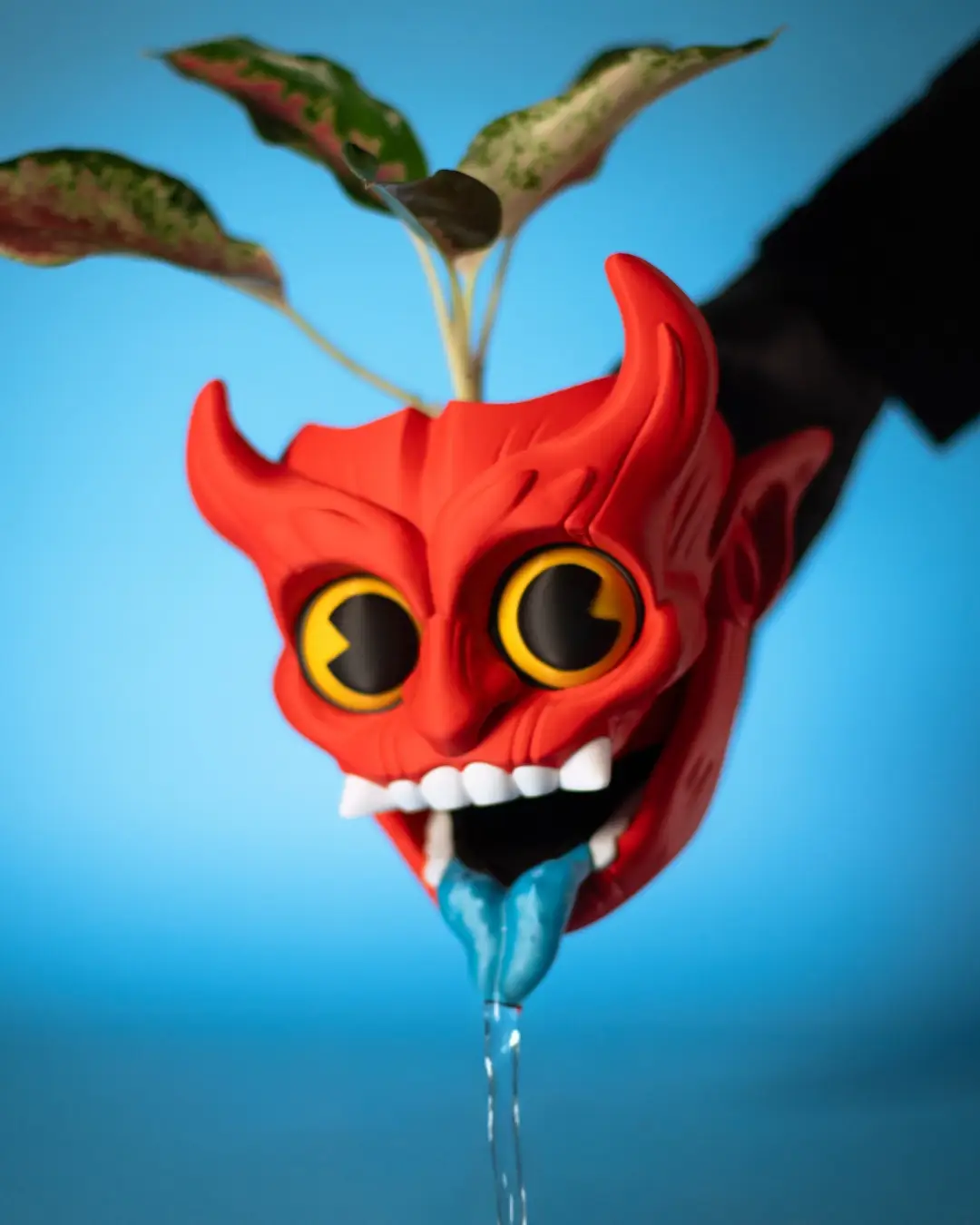
'The Oni Planter', 2026
What challenges did you face in the beginning of starting this project?
Not knowing how it would work out. And being truthful, I needed it to work out. I didn’t have a huge investment behind me. I started looking for other jobs, and I wasn’t having any answers to my call. So I said, instead of waiting for someone to come and ask me for something, I’ll just do and post.
It was difficult because it was new territory. I had never sold digital projects and didn’t know if people would like what I did. Starting over is always very difficult. Posting with zero followers on your Instagram account and saying, “Who will see this?”
But I had the experience of starting from zero beforehand, and I knew that I had to focus on the things I could control, which were the work I did and doing it over and over again despite having no results. I knew that eventually things would start accelerating a bit and having more momentum, and eventually it started to happen.
Even though it was a lot of work, it’s been six or seven months and it’s been great. It’s working out, and the best part is having people supporting your work and commenting that they love it and asking for more. All that support is great to hear and very uplifting. I think I took the right decision to try this out.
What are your main sources of stylistic inspiration?
I don’t know, really. Like I said before, I’m trying to find what my style is on the go. I don’t want to say, “Okay, my style is this and that,” and have it blocked off like that.
But when I think about it, there’s a lot of influence from my childhood toys. I think there’s a lot of Fisher-Price influence in the stylistic design. I don’t know if you remember a castle that Fisher-Price had with these figures. That’s my moment of happiness. With my designs, I try to go back to that every time.
But then I mix in more obscure, mythological, or memes from the internet. Having that acid and cute mix is something that I like a lot. Toy vibes, but with a darker theme. Adult Fisher-Price would be a good definition of what I do.
How do you choose your colors?
I think I have lots of influence from product design, maybe without knowing it. I’m very careful about choosing exactly what colors go where because I’m very careful about accentuating certain parts of the design. I have some color theory studies behind me, and I know how to make the attention go somewhere specific on the model.
I’m quite meticulous with that. But I don’t know why I like very vibrant and flashy colors. I tend to use that always.
When you pull from mythology, do you pull the symbols and then add your own colors, or do you pull colors from the mythology as well?
I like to get inspired by that mythology and symbols and everything, but always try to bring these Fisher-Price vibes to it. I think those flashy colors are part of that vibe. Giving it a toy language is something I like doing because it grabs your attention and makes you think about what this object is.
It’s not exactly a sculpture because I’m not trying to copy a Japanese sculpture of a dragon, for example. I’m trying to bring it to a more playful language, and I think that’s part of it.
How do you approach the source material for these inspirations?
I use a lot of Pinterest. I browse Pinterest for hours and hours. I’m not looking for anything specific, but I think those images get stuck in my head.
But it’s even better when I get to see them firsthand. A couple of years ago, I went to Japan for the first time, and I think that was a huge inspiration for some of the things I’m doing now. The power of the symbols that I saw on the buildings, on the temples.
I really get attracted to this when I see a 3D shape that is supercharged with meaning or emotion or symbolism. I try to understand why that happens, and then try to apply that same why to the work I do. It doesn’t always land, obviously, but that’s part of the pursuit.
What about mythology and symbols attracts you?
I don’t know where that comes from, but I think it’s part of seeing objects that can impact you so deeply or make you feel something. I’m always trying to understand why that happens.
Obviously, with religious symbology, that happens a lot, even if you are a religious person or not. You enter a temple, or you see a shrine or a statue, and it impacts you in a way. I’m trying to bring that to my work.
What I really like, or what I’m trying to do, I think, is bring some of that old world to this digital world that is getting born today. Trying to bring some of that meaning and symbolism to this digital world we’re building right now, and having it ready for people to download.
My parents are artists. They always studied more painting, but I always had sculpture books in my home. I think having read those as a little kid, something stuck with me. Maybe that fascination with antique objects and the fascination with my toys made a connection there. Now it’s the basis of what I’m doing, but it’s not a conscious decision I made.
Here in Argentina, there’s a folk hero that has shrines everywhere. You see red shrines on the road, and I’m fascinated by that. I don’t know why. When I travel by car, I want to stop and watch them, even though I am not devoted to that symbol.
There’s something about those kinds of objects that makes you respect them. Sometimes they give you an eerie feeling. Sometimes they attract you. Sometimes you feel devotion for them. But the idea that a 3D shape, because that’s what they are, at least in the way I think about them, can evoke so much is fascinating to me.
Were you always fascinated by architecture, buildings, and shrines?
Yes, I think there was always some kind of interest in that. When I was in this dichotomy of not knowing if I should pursue an artistic career or a more engineering-like career, one of the options was architecture because I felt like it was kind of the same middle ground. I ended up going for industrial design, design that focuses on other kinds of objects, but I think there is also an interest in architecture and its symbolism.
What technical constraints do you face with 3D printing?
There are lots of constraints. I’m talking mainly about commercial 3D printers you can buy and have at your home. There are obviously bigger and more expensive ones, but with the more accessible ones, the print volume has a determined space and size. It’s usually like a 25-centimeter cube as the maximum volume you can print.
Then you have material limitations. These printers print plastic, and that obviously limits what kind of objects you can do. Then there are geometric limitations because of the way the printer works. You can’t do any shape. You have to take into account that there has to be, for example, a flat surface where the piece sticks to the print bed. Then the piece can’t grow more than 45 degrees outward as it prints upward. The minimum thickness of walls has to be a determined one.
So you start getting lots of limitations on what you can or can’t do. But the truth is those limitations happen with any manufacturing process. I’m kind of used to designing with that in mind. If I were designing a metal piece for metal casting, I would have to go through the same mental process but with other kinds of limitations. Because of the career I chose, I’m kind of trained in having that kind of thinking when designing.
How do you deal with pieces that connect or assemble together?
You have to design taking into account what material you will be using and what the minimum tolerances are for 3D printing. 3D printing is not the most precise kind of manufacturing process, depending on what you’re preparing it for.
You usually have to design pieces that allow for certain deformation. If you don’t take that into consideration, maybe you print a piece in your home and it works, but then another person does the same at their house. Maybe they have warmer weather and the piece comes out differently, and it doesn’t work.
Luckily, plastic is kind of elastic, so you can play with that, like having gaps that open and close or fins that open and close. That’s something you train, and after a while you kind of know what will work and what won’t beforehand.
How long did it take you to master 3D printing?
I don’t think I’m a master of printing, but I’ve been working with it for 10 years now. I’ve gotten better, but the truth is that 3D printers have also gotten much better than they were before. Nowadays, you can rely on hitting play and having a finished piece when you go back to the printer. That didn’t happen before.
It was six years of studying a career that involved 3D modeling, and then 10 plus years of actually doing stuff. But I still have lots to learn.
What software do you design in, and what does that process look like?
I’m currently using mainly ZBrush. ZBrush is a software that is technically for 3D sculpting, where you treat the objects as if they were pieces of clay. I use a Wacom pen, but you could use an iPad, and it gives you a lot of freedom for making organic shapes. It’s very fun to use, at least for me, and it lets you play around with shapes very fast.
That’s for the more organic and artistic stuff. Sometimes, not always, I go to a parametric modeling software like SolidWorks. That’s what I use when I want to design mechanical parts, for example, screws or hinges or things like that. Then I import models from SolidWorks to ZBrush and finish the work in ZBrush. But I try not to go to SolidWorks because it’s not as fun as ZBrush. I’m getting better at ZBrush, so I’m being able to avoid SolidWorks altogether most of the time.
Then I export the file, and the software you use for 3D printing is called a slicer. Different brands have different slicers. I’m using Bambu Lab slicer, and that creates the file that ultimately the printer reads to print. That is called G-code.
What kinds of problems make you go into SolidWorks?
ZBrush is not very good at designing things with real measurements and real tolerances. In ZBrush, you can kind of import a sphere and make it more or less the size of something, and you’re kind of playing with that.
But sometimes in a product or a model, you need a certain screw with a certain tolerance and this kind of angle. Not only that, but if I try it out and have to change something, I don’t want to make it all over again. SolidWorks is very good with that. You model a very complex piece, but then you want to go back and change one measurement, and you can do that and the whole model updates itself.
That’s why it’s called parametric modeling. You can alter certain parameters without having to do all the work from scratch. It is a software mainly used for engineering parts, but having studied industrial design, I had to learn it. If you’re designing a part for injection molding, you have to use that software so that people then can make the models for injecting. I did communicate with engineers through that software. But yeah, I’m trying to get away from it.
Do you have trouble getting accurate colors from the digital model to the 3D printed object?
I don’t because I choose colors by looking at the plastic filaments. I use that as reference because I know if I start modeling or designing and choose any color I want, I will then have the problem of having to choose something that was not what I wanted in the first place.
When I start designing, I know that part of the decisions I have to make is, “Hey, this will be printed with this kind of filament.” I take that into consideration from the very beginning.
When you’re creating a 3D model that has interlocking pieces and moving parts, how much of the technical problem solving is done in the design phase versus the printing phase?
It’s 100% a design problem. I never leave things to be resolved in post-processing because I don’t think that’s the right approach for designing things. If I’m giving you a file for 3D printing, the work has to already be done in the design file.
Obviously, sometimes you have to assemble things, but I won’t ask you to screw a hole in the design. That was my job, to put the hole in there.
I’m very obsessive about those kinds of things. For example, in 3D printing, you can print more complex shapes using supports, meaning you’re printing a plastic part that supports your part while it’s being printed. I don’t like that. I think if you need supports for your 3D printed parts, you didn’t design the part well. I try to avoid those kinds of things and have the design as strong and as thought out as possible.
How do you feel about other people’s versions of your pieces existing in the world?
I love it. That was one of the things I was sad about finishing the last project. I didn’t understand how I would be able to get things into people’s hands without having this structure behind me.
Now this project is even better. I get a notification and I see that a guy from, I don’t know, Vietnam has printed my dragon and has it in his own hands, and he’s playing with it. It’s really magical for me. That’s the thing I love the most about this digital world and hyperconnectedness, which obviously has its bad side effects. But having this ability as a designer is mind-blowing, and it’s something that didn’t exist prior to 3D printing and this whole ecosystem.
In the last 10 years, I saw it be born. When I finished college, this opportunity didn’t exist for me. I had to get into a studio or a business, and they would handle the manufacturing. Now having the ability as a creator to do something in my living room and have someone from the other side of the world print it and enjoy my work is totally awesome and blows my mind every time, to be honest.
Can people print your work in different colors?
Yes, they can. That’s one of the things where I had to let go of my control freakness and say, “Print whatever color you want, man. Just enjoy it.” Obviously, as a designer, I’m very careful about what colors I’m choosing and everything, but then the other person can do whatever he wants, and that’s okay. I’m fine with it now. I had to work on that.
How much thought goes into how you photograph your finished pieces?
A lot of thought goes into that because I consider myself a very amateur photographer, but it’s kind of one of the things that I’m trying out now. I had never done that before this project, and I’m really enjoying it.
Not only the photography, but also all the storytelling behind making content for social networks, Instagram too, and everything. It’s one of the things I have less experience with and maybe one of the things I’m most enjoying right now.
I know a lot of creatives maybe struggle with that. They say, “Hey, but I want to be an illustrator, so I don’t want to make videos and everything.” But in my case, again, I think it the other way around. I think, “Hey, I have the opportunity to tell a story in this medium without asking permission to anybody. So let’s take it.”
Maybe it’s one of the areas where I feel less confidence because I trust my design skills, but my storytelling skills and video skills are maybe not at the same level. But I’m enjoying the process of learning that.
'Tláloc the God of Rain', 2026
Has there been a piece that surprised you once you physically held it in your hands?
I think the Imperial Dragon. I kind of knew that I would like it because I was liking it in the model, but it wasn’t until the first prints came out and I had it in my hand that I said, “Man, this is awesome.”
I was proud of my own work, like a kid. It took me a little bit back to having that Fisher-Price castle, but made by me in my hands. I said, “Hey, I made it.” That’s one of my favorite pieces so far. That shock moment was the moment I fully assembled it.
How did it feel the first time you held one of your own designs?
It was kind of magical, to be honest. That feeling of, “Hey, I thought about this. I actually 3D modeled it detail by detail, and now it’s in my hand.” It happened so fast, in a couple of hours. It’s awesome, and I don’t get tired of that. It’s part of what I love about my work.
Also, the possibility of having it in your hand and knowing that now anybody can have it. I can publish the file and anyone can have this experience or have joy with these objects the way that I’m doing right now.
I think designers are having our moment that maybe musicians or photographers had 20 years ago, when they were able to share their work. That opportunity came to us a little bit later, but it’s here now. Anybody can buy a 3D printer. I think there are very good printers, maybe cheaper than cell phones. Obviously, it’s maybe not for everyone. You have to have the interest. But I can now, as a designer, share my work without any intermediaries or borders between me and the people, and that’s awesome.
Is there a design you’ve wanted to make that you haven’t been able to make yet because of technological constraints?
What limits me is scale, the size of things I make. I would like to make furniture, for example, in the style of Spicy Plastic. I don’t because I think people won’t take the time to print for weeks and assemble it. Maybe I’m wrong. Maybe I should try.
The biggest limitation nowadays is that. Sometimes it happens to me that certain objects I don’t do because of the materials. I don’t want to do anything that’s for food or drinks, for example, because the plastic you use is not the best for that, so those kinds of designs I discard. But who knows, eventually maybe 3D printers of other materials get cheaper and better, and Spicy Plastic has a bigger catalog of cups and plates.
Do you think you’ll ever make something like a monument or public sculpture?
I’d love to. I always have this idea of maybe making a statue and placing it in a public space without asking anyone, and seeing what happens. But again, I think the scale of it is stopping me from doing that. Eventually, I’ll do something like that.
What project are you most proud of so far?
I think the whole planter series I’m making right now. I really like it. It clicked with people also. People are asking for more planters, more designs.
I have a personal preference for the one that started it, the skull design. It was one of those projects where you come up with the idea and say, “Hey, this is an awesome idea.” I sat down and made it in a day or two and printed it, and it came out without any issues or problems. People loved it, and it was one of those projects that you dream of. It was so joyous to make, people loved it, it came out easy and fast, and it started the whole collection. I think that’s maybe, up to this day, the one I’m most proud of.
But I hope there’s more coming. I kind of get tired of things and want to make new things all the time, so maybe if you ask me next week, it will be another one.
What can we expect from Spicy Plastic on the horizon?
I don’t have a master plan, to be honest. That’s what I love about it. My plan is only the next rock, and I found out that’s the way I love working. It also takes me to the best place. I start trying out crazy things, and if they don’t work, they don’t work. I try new things, and eventually I land on good projects.
The thing I think about to not get caught up in ideas is that I want to make 100 designs for this project, and then I start thinking about long term and everything. But I’m kind of in this mentality of, “Hey, just make stuff because you want to and don’t overthink it too much.” I think that’s the way I found to get the best out of me.
So if people want to know what to expect, at least 100 designs in a row from Spicy Plastic.


Articles
Magazine
Submissions