

Painting
Illustration

Isabel Lauren Loewe

'Counting Petals', 2026
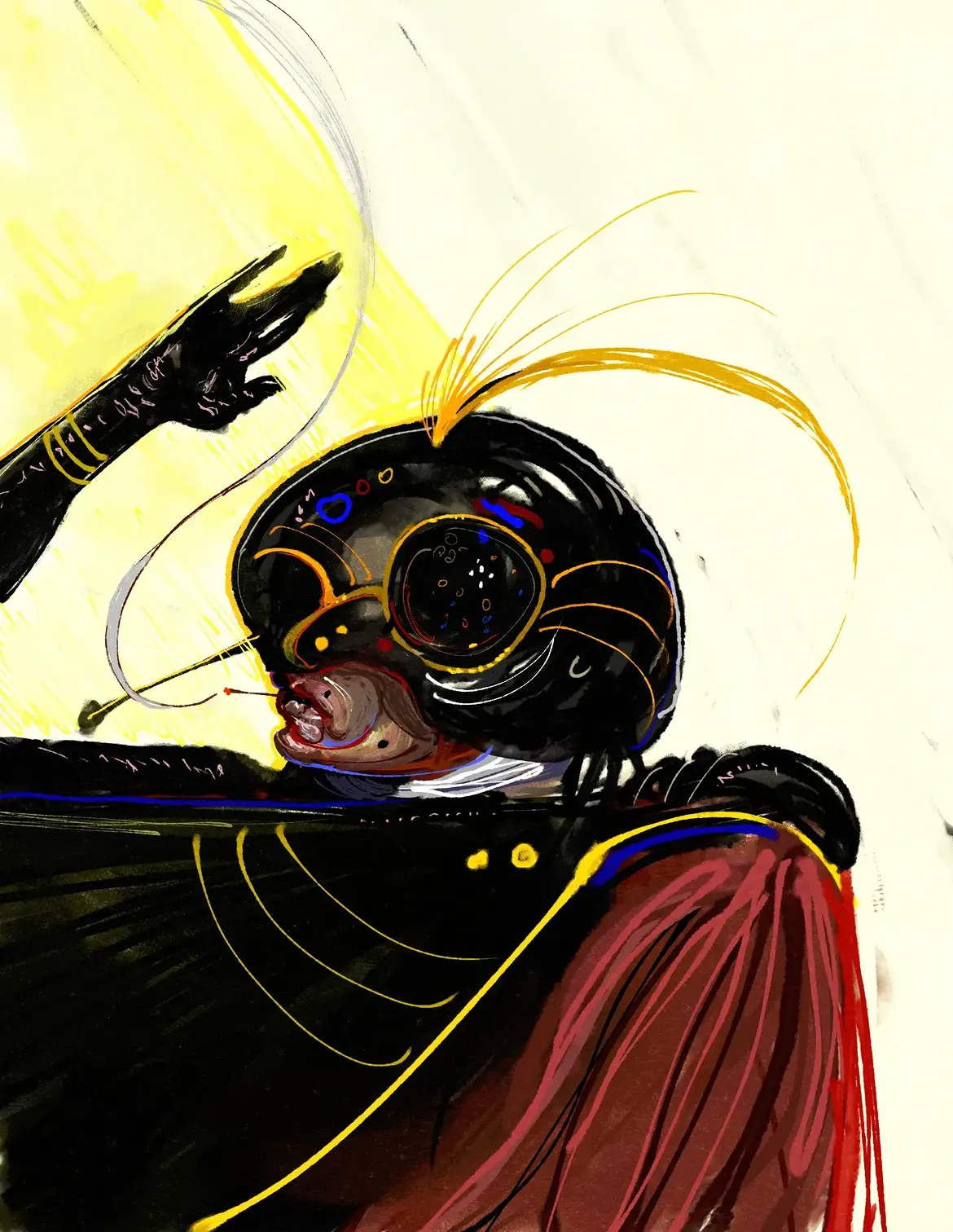
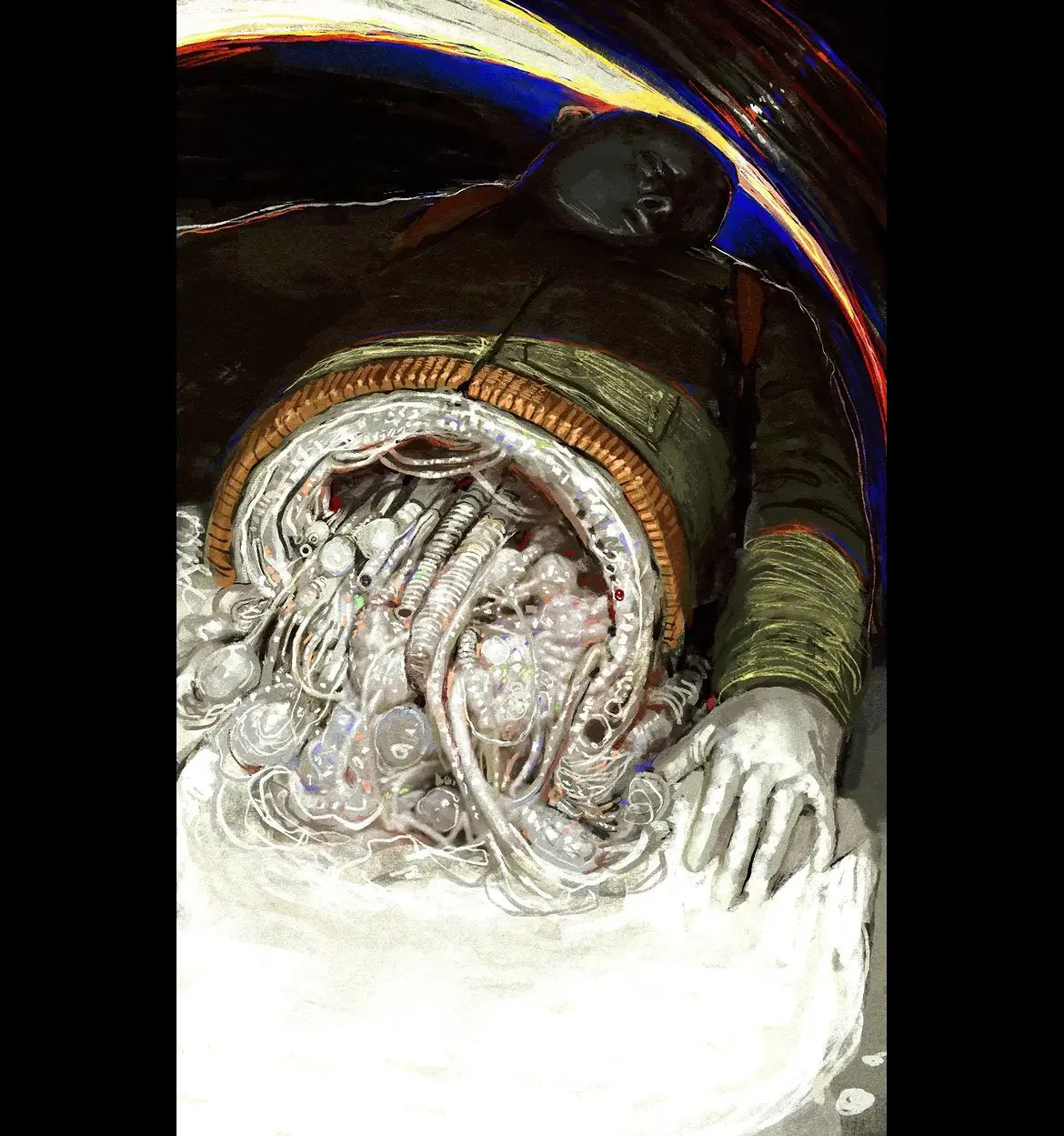
Chancellor’s paintings feel like they have been dragged out of a house no one wanted to look inside. The bodies are heavy, the colors are sickly, and the surfaces seem to sweat with whatever has been left too long in the dark. His figures often appear caught between vulnerability and threat, intimate enough to feel human and strange enough to make that humanity uncomfortable. The horror in his work does not arrive as decoration. It comes from the feeling that something deeply personal has been made visible.
That visual language grew out of childhood obsessions and a world that felt too clean in all the wrong places. Raised Mormon in small-town Utah, Chancellor remembers being surrounded by art that was reverent, polished, and spiritually instructive. It did not connect with the house he grew up in, or with the poverty, mess, queerness, anxiety, and bodily reality that shaped how he saw things. Monsters made more sense. So did dirt, blood, contradiction, and anything that refused to behave.
His style now carries that refusal into digital painting. He is drawn to color that feels aposematic, the kind of warning color that makes a viewer hesitate before coming closer. He wants bodies to feel lived in, compositions to hold tension, and beauty to survive inside images that might otherwise turn away from it. “The art that interests me is rough and full of contradictions,” he says. In Chancellor’s work, dread and tenderness keep pressing against each other until the image starts to feel alive.

'Microplastic Vignette', 2026
Who are you, and how did you get started making art?
My name is Chancellor, and I’m an illustrator! I’d say I’m a pretty standard case of an artist who has been infatuated with drawing since before I can remember, so it’s tough to pin down an exact moment. I do have a vague memory from when I was little, probably around the age of 5 or so, of my dad drawing in a sketchbook with me. Watching someone draw when you are 5 years old is magical. That definitely planted a seed.
As for when I started taking the idea of making a career out of art seriously, that was around 2017 or 2018, after graduating high school by the skin of my teeth with a 2.0 GPA. I couldn’t afford college, and I had spent my whole life hearing people complain about the nightmare that was student debt, so I decided not to pursue that direction. But that kind of left me without a direction in life, so I was struggling a lot with what exactly I wanted to do.
I figured I always liked drawing, and the idea of being a concept artist on a video game sounded exciting at the time, so I found some YouTube videos on how to get better at drawing. Coming up on 10 years later, here I am.
What were your earliest inspirations?
My dad for sure. He was a really skilled hobby artist who was always drawing comic book heroes and monsters and the like. All the coolest things in the world for an adolescent kid.
Another big inspiration to me was this kid in 6th grade who I was friends with. I forget his name, but he was always drawing, which made him seem really cool to me. I joined the art club because he was in it, and I wanted to spend more time with him. Looking back, I think I had a crush on him. He moved away to Oregon toward the end of that school year.
Also around that time, my parents bought me Arthur Spiderwick’s Field Guide to the Fantastical World Around You for a birthday present, and I would trace the monsters in it to bring to school to show my friends and then claim that I drew them myself. I also did this with DnD Monster Manuals and Yu-Gi-Oh! coloring books. It was very sinister. Pretty much, I just loved monsters.
Were you always drawn to dark subject matter, or did that come later?
It’s always been a big part of it for me, for sure. You kind of can’t be afraid of wandering into darker territories when you are a kid infatuated with fantasy monsters. They wouldn’t be very monstrous if they didn’t want to kill you.
I think another part of it was a rejection of the clean, pretty, and reverent art I was surrounded by as a kid raised Mormon in small-town Utah. It was all so sterile. Things that didn’t really connect with my experiences being poor and living in a filthy, unkempt house. There were paintings to remind you to read your scriptures and to say your prayers and do your chores, and paintings that reminded you that Jesus loves you. Those were boring. Blood and guts were cool.
Growing up, I do remember seeing this one artist, Walter Rane, whose paintings were in a lot of the books at church, and I did love looking at those, so there were the occasional exceptions. His paintings featured some very dramatic compositions and were full of filthy people wearing dirty rags. Things that felt a little closer to home.
There is this one from him titled Good Samaritan that has always stuck with me. It’s a depiction of the titular story from the Bible, featuring a beautiful man who would be completely naked if not for the incredibly loose loincloth around his waist. The Good Samaritan holds him so tenderly while inspecting his wounds. There are two red flowers, soft and quiet, in the foreground to parallel the figures. Mormons love painting beautiful men holding each other in profoundly loving ways, and I’m a big fan of that, so I’ll give them some credit there.
Another one of his that I love is I Will Not Let You Go. It’s really romantic. He is Mormon and is probably really lame politically as a result, so take these recommendations with a grain of salt.
How did you find your way to digital painting specifically?
One of my biggest struggles with art growing up was my impatience. Waiting for paint to dry, yadda yadda. Digital art let me approach art in a way that was a little more friendly to that lack of endurance. No going to the store to buy more supplies, or dealing with setup and breakdown. Nothing to get in the way of me sitting down to draw the thing I wanted to draw.
Plus, I’ve always been fond of spending time on the computer. I do still dabble in traditional art here and there, and it is a goal of mine to do more of it. I think I have a lot more patience now than I did then.
What did the early work look like compared to what you make now?
Unrefined, I guess? And limited? I didn’t really have the technical abilities to steer where my work went or the muscle to work through challenging problems, so I was kind of stuck making art that I knew and was comfortable with.
I think I really started to find my ground as an artist when I leaned into experimentation and when I took the time to study and practice the fundamentals of painting and drawing. Putting myself in situations where I didn’t know what I was doing, and working my way through them.
You work primarily in Clip Studio and Rebelle. How did you land on those tools, and what do they each give you that the other doesn’t?
The first program I ever worked in was Photoshop, but I got dicked over pretty heavily by Adobe’s ridiculous subscription cancellation policy during an incredibly broke moment of my life. I had something like $20 to my name, and they overdrafted me $200. So Clip Studio offering a one-time purchase for $50ish was an easy sell.
Rebelle caught my eye with its incredibly textured brush system. Its impasto and watercolor simulations were exciting and a lot of fun to play around with.
What advice would you give to young artists who are finding their specific style?
I think I would tell them that the goal of finding a style is a pretty arbitrary one. You may as well be asking, “How do I find my accent?” You don’t! It comes to you as a natural part of the process.
I think it’s far more important to spend time interrogating your relationship to art. Why do you do it? What is your process? Who or what inspires you? Why do they inspire you? What can you accomplish, and what can’t you? What do you want to accomplish?
I think by building up that introspective process alongside your technical abilities, everything else tends to fall into place.
That’s not to say style isn’t a real, tangible thing. It is. But I think I see a lot of young artists who get stuck in the trap of thinking about style the same way one would think about changing the font in their Word document. It’s important to understand that art is a kind of language. Your style is the way that you go about communicating.
To learn whatever language you speak or write, you had to learn all the letters in its corresponding alphabet, what sounds they make, how to connect them to make words, and then what those words mean so you can use them in a sentence. That’s a lot of different components you had to sort out just to be able to string together even rudimentary language, let alone any kind of poetry.

'Knife in the Sink!', 2024
How long did it take before you felt like your technical skills were keeping up with what you were trying to make?
It took the better part of 10 years to get to a place where I was consistently confident with my technical abilities. Even now, I still hit boundaries pretty frequently. The difference is that when I was younger, hitting a wall felt like the end of the world. I can’t draw a hand, so I’ll never be an artist.
Now when I hit that wall, it’s just a matter of stepping back and breaking stuff down, brick by brick. What is not working and why? What am I going to do about it? And then I’ll do a couple of studies about it and be on my way.
How do you balance technical skill, rendering, color harmony, anatomy, and perspective with your desired feeling? Do they compete at times?
They do! But I think my trick is letting them compete. The art that interests me is rough and full of contradictions. I’d say the Troxler effect is a kind of guiding principle for me. Our brains make sense of the world through a constant process of comparison, and without that information, everything just kind of disappears into nothing.
We understand hot because it’s not cold, and vice versa. A chef might dress a savory meal with a sweet glaze to provide a point of contrast. A theatrical production might precede a chaotic stampede with a moment of stillness. I like to seek out those edges, and I think my work would lose a lot of its power if I leaned too hard into making things harmonious.
You’ve cited themes of class, queerness, filth, and religion. What are you trying to say about those topics?
A great question, and one that is kind of tough to answer because I don’t think there’s really any one grand message I’m setting out to proclaim. I grew up poor, Mormon, and gay in a filthy house full of hoarding. That played a very heavy hand in shaping the world around me and my perspective on it, and that went on to shape my art.
I think generally my approach is about exploration. When I’m working, I’m asking myself questions. What does it feel like to live in the world that I do? What does it look like? So I guess by answering those questions, what I’m trying to get across is my lived experience. I’m saying to the viewer, “Hey, this is the kind of world I live in. Here’s how it looks and sounds and feels.” I hope they walk away from it thinking more about the world they live in and their relationship to it.
Individual pieces might get a little more specific than that. Like my pieces Chimera and Widowmaker, which I made to work out some thoughts I was having about rejecting assimilation and respectability in my queerness. Plates and Glasses and Everything I’ve Yet to Put Away, I made while working through the exhaustion I felt keeping up with the maintenance of day-to-day life while struggling to make ends meet working full time.
I think with a lot of my work, I’m not necessarily setting out to say something as much as I’m setting out to interrogate some part of my life. That’s not to say that there aren’t any messages in my work. I think it’s pretty apparent that I want the viewer to walk away from it with something. I just hope they approach it from angles that are a little more interesting and thoughtful than a = 1, b = 2, c = 3, therefore a + b + c = 6.
Your work would make Giger blush. What on earth could possibly be your main sources of inspiration?
I pull inspiration from a lot of sources, but if I had to pick my biggest ones, I would point to the work of Ivan Albright, Enrico Robusti, Roj Friberg, and Martin Wong.
I love the filthy honesty of Ivan Albright. His paintings are wretched and sickly. He spares no details, rendering out every strand of hair and every piece of dirt to a degree that is nauseating. I think the thing that strikes me the most about his work, though, is that he doesn’t use these things to degrade or belittle his subjects. Instead, he uses them to build up an immense and overwhelming sense of humanity.
When I look at his paintings, I think about the house I grew up in and how it felt to live there. I think about how uncomfortable I felt visiting my grandma, who kept a perfectly tidy house, or having to go to church wearing wrinkled, mildewy clothes to listen to a sermon about Jesus tending to the unclean lepers. It felt like I was tracking mud onto people’s carpets everywhere I went. To me, Ivan understands the humanity of filth.
Enrico Robusti’s paintings are loud and obnoxious. Everyone is screaming and in your face. They are chewing with their mouths open and picking their noses. They are singing and dancing and kissing and crying! I’m blown away by the liveliness of his work and, in particular, the way he uses movement and perspective to capture that chaos. I like him for reasons very similar to Ivan Albright. He’s honest about his subjects in a way that really captures a sense of soul.
The worlds Roj Friberg paints are haunting and lifeless. They are full of polluted beaches and rusted ships. Spilt oil and dead whales. He paints sunken bridges and the ghostly shadows of disasters long past, looming over already devastated cities. I think it would be easy to treat his work as nihilistic, and maybe it is, but living in a world that’s already blown past any hope of outright preventing climate catastrophe, I can’t say these things don’t resonate with me. I get the sense that he’s mourning, and I find myself mourning with him.
Where Roj Friberg might be nihilistic, Martin Wong is deeply in love with his hope for the future. His paintings are also filled with the tragic rubble of a long-devastated world, but in that rubble he finds two firemen kissing. He finds a community full of life. Bands playing music, people dancing, kids skateboarding, and dogs fetching toys. When Martin Wong looks up, there’s a sky full of stars! I find that joy infectious.
I think I’ve probably gone on long enough there, so I’ll let the readers pull the throughline on those points of inspiration.
How did you get into disturbing people with your art?
When I was a teenager, I would volunteer a lot to work in haunted houses as an actor, and I think that definitely laid a strong foundation. It was exciting to cover myself in liquid latex and fake blood and crawl around on the floor. People screaming in terror and running away was a compliment.
Your bio names horror, surrealism, and expressionism as touchstones. How do those three interact in a single piece? Do you think of them separately or as one combined pressure?
I don’t really think of them separately, especially because all three of those disciplines overlap in a myriad of ways. But I suppose I’m drawn to horror as a tool because I like its confrontational abilities. Surrealism, because I like being able to approach the mundane from an angle that forces me to reconsider it. And expressionism because I like the sincerity that comes from trying to capture the abstract. I think all of those things support each other in really useful ways. So definitely a combined pressure.
Your work carries a very specific mood, something between dread and intimacy. How consciously are you building that?
I’d say it’s very intentional! I think it’s hard for something to really be dreadful if there isn’t some kind of vulnerability. Intimacy provides that. On the flip side, it’s hard for something to feel intimate if there isn’t some kind of sense of danger or risk. Dread provides that. They complement each other in very natural ways.
How do you think about color in work that operates in such dark registers?
I would say my approach to color is aposematic. I want my colors to be sickly and garish because I think it helps my work communicate its intent a little more clearly. I want the people who take a bite out of my paintings to walk away feeling nauseous.
Your figures have a physical weight to them even in the most surreal contexts. How do you approach the body?
Generally, I like the people I paint and their bodies to feel real and lived in. Giving them a tangible sense of history is an important part of that process for me. I want them to feel human in the way that I do in my body. I think maybe that physical weight is a natural byproduct of that process.
What does it take to disturb you?
Honestly, not a lot, and that kind of demonstrates another function art has had in my life. I, like most people, have had more than my fair share of turmoil to work through. I’m an incredibly anxious person with a bad habit of staying too long in the imagined worst-case scenarios.
Painting kind of gave me room to explore and confront those things in a more productive and healthy manner. Like exposure therapy or a journal. Or maybe like picking at a scab.
What do you think your art says about you, and what do you think your work is actually about underneath the surface imagery?
I’m not really sure. I hope it says I’m thoughtful and curious. I hope it makes me seem interesting and cool. I think that would be nice.
I think it would be tough to pin down anything in particular that I think is lurking beneath the surface because I wear my heart on my sleeve when it comes to art. If I had to pick one big umbrella that my work fits under, I guess it would be about curiosity and investigation, because so much of my process is about using those tools to explore the world around me. But that’s really broad, so it’s tough to say how useful of an answer it is.
What does your process look like from the beginning of a piece to the end?
My process varies a ton, but most of my pieces start conceptually. Usually something strikes me as interesting while I’m navigating my day-to-day life. Sometimes while I’m watching a movie or playing a game or reading the news. I’ll typically jot the idea down in a notepad or take a picture of what caught my eye and save it to an album. Sometimes I’ll sit on the idea for months or years, and sometimes I sit down that same day to start doing roughs.
During that rough draft phase, I’ll spend a lot of time hunting for references and visual inspiration and make one big moodboard of it all. I like to do three or four quick rough drafts, just sketching in black and white to see what sticks compositionally.
After I nail a composition I’m happy with, it’s just a matter of rendering. That’s usually the quickest part of the process. I think that’s because I spend so much time figuring stuff out in the beginning stages. I like to work that way. Building up a strong foundation to work on helps me finish stuff with a lot of confidence.
How long do your pieces take, and how do you handle a piece that isn’t working?
That varies a ton as well. There are pieces that I’ve taken years to finish. My painting Knife in the Sink is a good example there. Unsurprisingly, the idea came to me while I was doing dishes, and I remember sitting on it for a few months before attempting some roughs. When I eventually did, I was really unhappy with it, so I threw it on the back burner. It was like a year later that I felt confident enough to sit down and take another swing.
On the flip side, there are some paintings I knock out in a day or two. Dendroecology // What Lies Between I did over a weekend while I was out of town visiting family.
I’m a really big fan of throwing everything away and starting over from scratch when I hit that wall. It was a hard thing to learn how to do. It’s really easy to be overly precious about one’s work. But once I did get the hang of it, it felt like unlocking a superpower. It’s so much easier problem solving when you are able to take a big step back to reevaluate the bigger picture. It’s much harder to do that when you are ramming your head into it.
Do you ever stray from your horror style? If so, why?
I do! Actually, I’d say some of my favorite pieces I’ve done are ones that stray from horror. Study of a Crate of Heirloom Tomatoes was a piece I painted after I saw a beautiful crate of heirloom tomatoes sitting among a pile of cardboard crates in the produce shipment at a restaurant I worked at.
Another one, Let’s Eat a Tomato, Together, what can I say, I love tomatoes, was something I painted after being inspired by a TikTok video I saw of a guy eating a tomato with salt and pepper by candlelight in a dark room. The video had like 20 views and was two minutes long, and he was no more than six inches away from the camera. Just me, him, 19 other viewers, and this juicy tomato. The only thing he said was, “Let’s eat a tomato, together,” and it made for a really great title. It was so intimate.
Can You Feel the Sunshine? was conceived during a three-week period of my life where I couldn’t stop listening to the Sonic Racing OST.
I think I’ll probably always embrace elements of horror in my work. Horror means a lot to me! It’s a powerful tool that’s provided so much catharsis in my life and helped me work through a lot of difficult things. And I think by embracing the horrific and terrible, my work that sets it aside to explore the beautiful and wonderful becomes a little extra impactful. Like that final scene in Texas Chainsaw Massacre where the girl is escaping in the back of the truck and Leatherface is dancing in the sunset.
You’ve done commissions for games like METAMORPHOSIS and illustrated for publishers like Lost In Cult. How does working within someone else’s world change your approach?
It doesn’t change my approach too much, actually. I think because I’ve structured my general process around the industry standard of concept to rough draft, revisions, and final draft. I learned that from my early days of watching YouTube videos about how to be a concept artist, and it has helped make my transition into a career artist a lot smoother.
What does a brief from a client look like for you? Do you welcome constraints or resist them?
There’s not really any one way I get briefed by clients. It varies a lot case to case. Sometimes I get briefs with a lot of information fleshing out a very concrete project, and other times I get briefs with very little information running mostly on vibes. I think I’m fine working with either as long as it sounds like an interesting project that won’t be a huge pain in my ass. Hopefully it pays decently as well.
Generally, I’m always going to love a client that lets me do what I want, but I do appreciate a good constraint or two because of the way it forces me to approach things outside of my comfort zone. Which is an area I think I’ve learned to work well in as an artist. That being said, there are definitely limits. At a certain point, if a client is overdoing it on all the ways they don’t like my approach, it kind of just starts feeling like a slap in the face. Like, if you don’t want anything to do with my vision, why did you hire me?
Also, sometimes you get clients that talk to you like they are talking to ChatGPT. “Okay, I like this, but rotate the figure by 15 degrees.” “Okay, now make them smile.” “Okay, now make them frown again, but different this time.” “Okay, that’s good, but can you draw them in a completely different environment?” “Okay, now make them smile, the frown is too sad.” Those are a nightmare.
Also, while on the subject, I do think it’s important that the constraints have some kind of intention making the project more interesting backing them up. Pointless and arbitrary limitations are annoying. Luckily, most of my clients I’ve worked with have been lovely, though.

'Let's Eat a Tomato, Together', 2026
Is there a tension between the work you make for yourself and the work you make commercially, or do they feed each other?
Learning to work with other people’s visions will always be challenging in one way or another, and honestly, it’s something I struggled to do for a really long time. To the point where I refused to take on commissions and stuck to personal work only for a good many years. During that time, I completely abandoned any idea of making a career out of my art.
A lot of that struggle came from a lack of confidence in my work, though, and a ridiculously high set of expectations for myself. I felt pretty strongly that every piece had to be my best piece. My ego was very attached to everything I did. Eventually, after getting some more experience developing my technical skills, and pulling my head out of my ass a little, that completely flipped on its head.
I’ve really grown to love working with other people’s visions. Some of my best work is things I never would have painted if I didn’t put myself out there to tackle the challenge of collaboration. The key arts I did for METAMORPHOSIS, Heavy as Stone, and Machine Games are dear to me. I think they are the most fun I’ve had working on a project.
I’ve done five album covers at this point, and every single one of them I would also put on my “favorite projects I’ve worked on” list. I think there’s something really exciting about getting to marry my work to the work of others. And looking back, I think working only with myself was really lonely. I do still like finding time for personal pieces. That’s always going to be there.
I think I would struggle a lot more with my relationship to client work if I was doing it for stuff I didn’t care about. But I’ve always loved video games and music, and that’s mostly the kind of work I get. It’s hard to complain when you are working with cool people on cool projects. In fact, I would even say I’m grateful for it.
Your fan art, the Silent Hill studies for example, seems to operate differently from your original work. What does working within an established aesthetic give you?
I think it gives me room to play and experiment, and to develop my work by doing so! Fan art is a great way to reconnect with the fun parts of making art. It gives me a way to explore approaches to style and subjects that I wouldn’t normally consider. I think of it like going out to play frisbee or volleyball with friends to get your exercise versus going to the gym. I could sit there and lift weights and run on treadmills, but that sounds really lonely and miserable. It’s a lot more fun to make a game out of it.
It also helps me blow off creative energy when I’m dealing with creative blocks by giving my work a grain to nucleate around. It’s also a great way to engage with the art I find inspiring. I could play a game, or watch a movie, or read a book and be done with it. But I get so much more out of it by sitting down to work through my thoughts on a piece of fan art. How do I build on the work? How do I convey the way it made me feel? What do I think about my relationship to the subject material?
Overall, I think fan art has made me a better and more capable artist than I would have been if I had abstained from it for the sake of some imaginary artistic integrity. This is a bit of a tangent, but I’ve always found the attitude that fan art is a lesser form of art that plagues social media to be a little self-important. Okay, Picasso, I’m sure your work is very thoughtful and important! Good for you!
I understand the frustrations about how well fan art does on social media compared to other kinds of art, and how prevalent it is as a result. But to me, those issues are more about the ways social media is generally structured to favor a very narrow category of art than it is about fan art itself. I would encourage artists who only ever make fan art to maybe branch out and try some other things, but I would also encourage artists who think they are above the lowly medium of fan art to give it a try. At the end of the day, some variety is probably going to be good for you. But to each their own.
How do you think about building a body of work rather than individual pieces?
That depends a lot on the kind of body of work I’m building, but generally, I’m fond of setting rules and boundaries to work within, and then after a while finding interesting ways to break out of them. I think that’s a good way of keeping things interesting and yourself reasonably engaged in a thoughtful process.
Limitation breeds creativity, but if you work too long within a set of them, I think they can wrap back around to being a comfort zone. At that point, forcing yourself to work outside those bounds can be just as intimidating as setting them. Like, what the hell do I do when I can do anything?
Your following has grown significantly. How has that changed, if at all, the way you approach what you put out?
I’d say that it hasn’t really affected my approach so far, but that growth is still a very recent development, so it’s hard to say at the moment. Maybe sometime down the road it will affect me? It has provided me lots of work and opportunities, which I’m grateful for! And I’ve gotten to know a lot of artists I looked up to beforehand, which is crazy. So it’s at least had some positive effects on my life.
Is there an audience you’re specifically making work for, or does the right viewer find it?
I think the latter. Ultimately, with most of my work, I’m striving to make something that I personally find interesting, so I don’t really think too much about a specific audience. I’ve definitely developed one over time, but I couldn’t really tell you what exactly unifies them.
Maybe they’ve lived similar experiences to me and have found something relatable? Maybe they find my stuff weird and fascinating? Either way, I’m glad to be reaching people. It’s a nice feeling.
What do your parents think of your work?
Generally, I’d say they are both proud of what I’ve accomplished. I do think the subjects I tackle make my mom a bit uncomfortable. She would probably prefer I painted the clean, pretty, and reverent things that Mormons are typically fond of. The kind of art I make is right up my dad’s alley, though.
Horror as a genre has a complicated relationship with sincerity. How do you navigate that?
I think horror as a genre benefits a lot from sincerity. It’s predicated on being able to open up enough to show your audience exactly what your fears and anxieties are, and that often requires stripping your subjects down to their most vulnerable. Now, horror covers a massive amount of territory as a label, so it’s going to be very case to case, but I think any horror that doesn’t employ sincerity as a tool is going to run into a lot of challenges.
I navigate it personally by embracing it, but I’ve always been really sincere in my approach to art, so I didn’t exactly have to change much.
Is there something you want to make that you haven’t figured out how to make yet?
Oh, there’s so much. I think learning how to paint opened up a world of possibility for me. If I can learn that, I can learn anything that I want. I’ve started dabbling in music and 3D modeling and jewelry and coding. I can’t wait to see where I’m at with those later on down the line.
What advice would you tell your younger self in relation to your artwork?
Honestly, I think I would tell him to keep doing what he’s doing. He’s on the right path. I like where I’m at.



Articles
Magazine
Submissions