

Digital
Design

Isabel Lauren Loewe
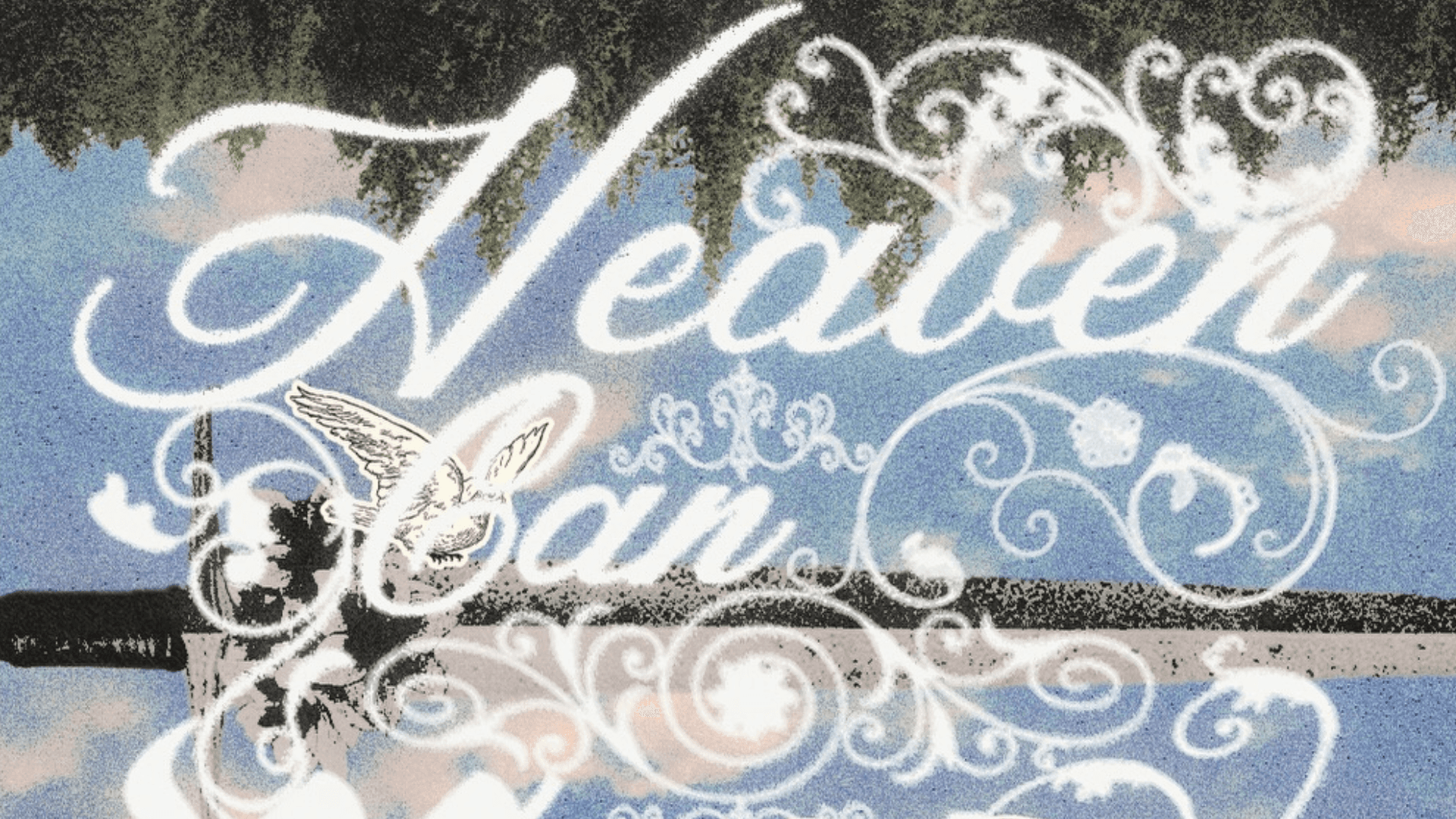
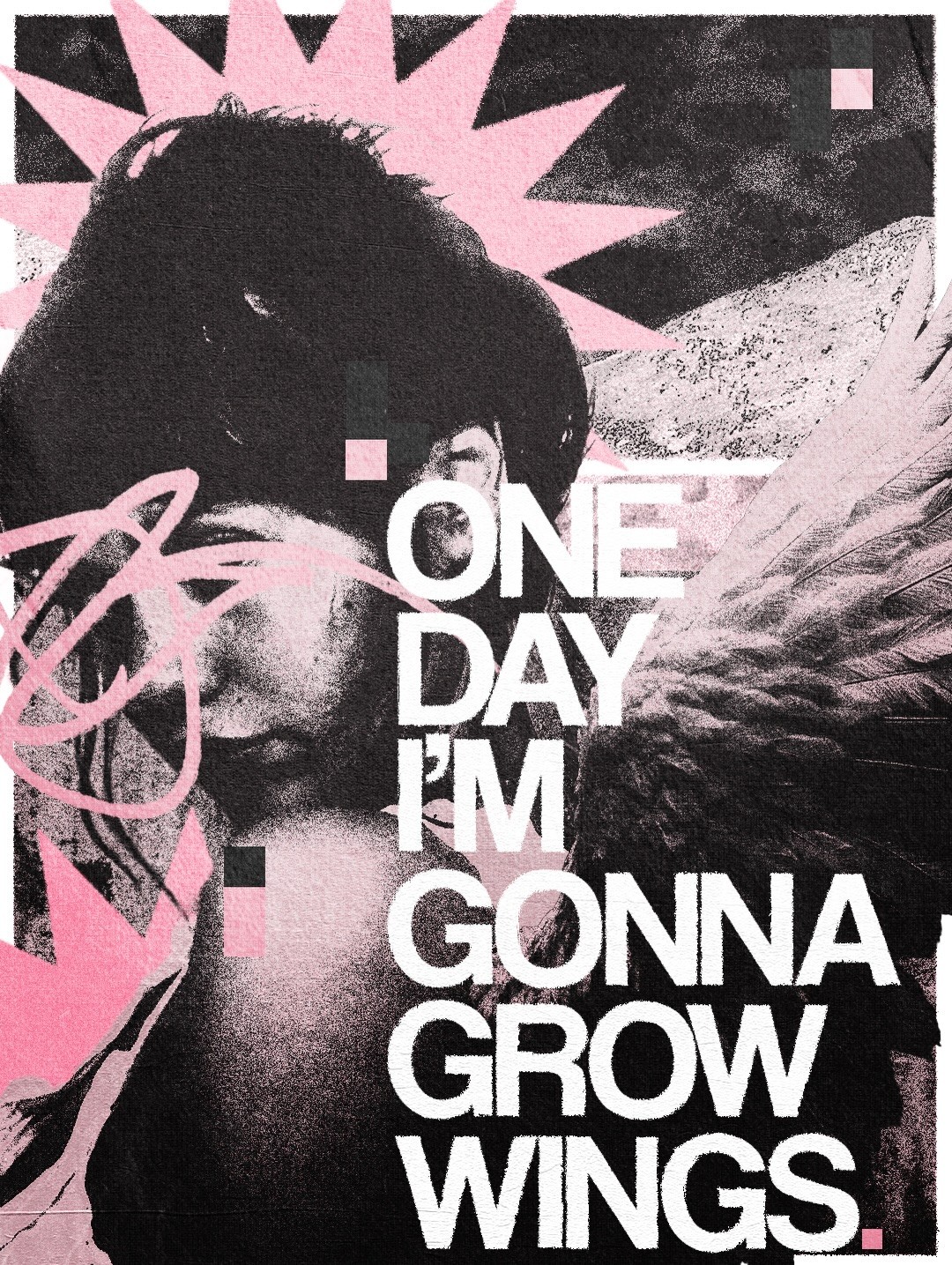
'Heaven Can Wait', 2026
There is a specific kind of nineteen-year-old that Genesis Bullets is not. He is not the one who has decided that not caring is a personality, that nonchalance is cool, that being a husk is fine. He has strong opinions about that type and they show up in his work before he ever has to say them out loud. His designs are loud and pressurized, grain and crumpled paper and threshold distortion stacked until the image feels like it's about to give out.
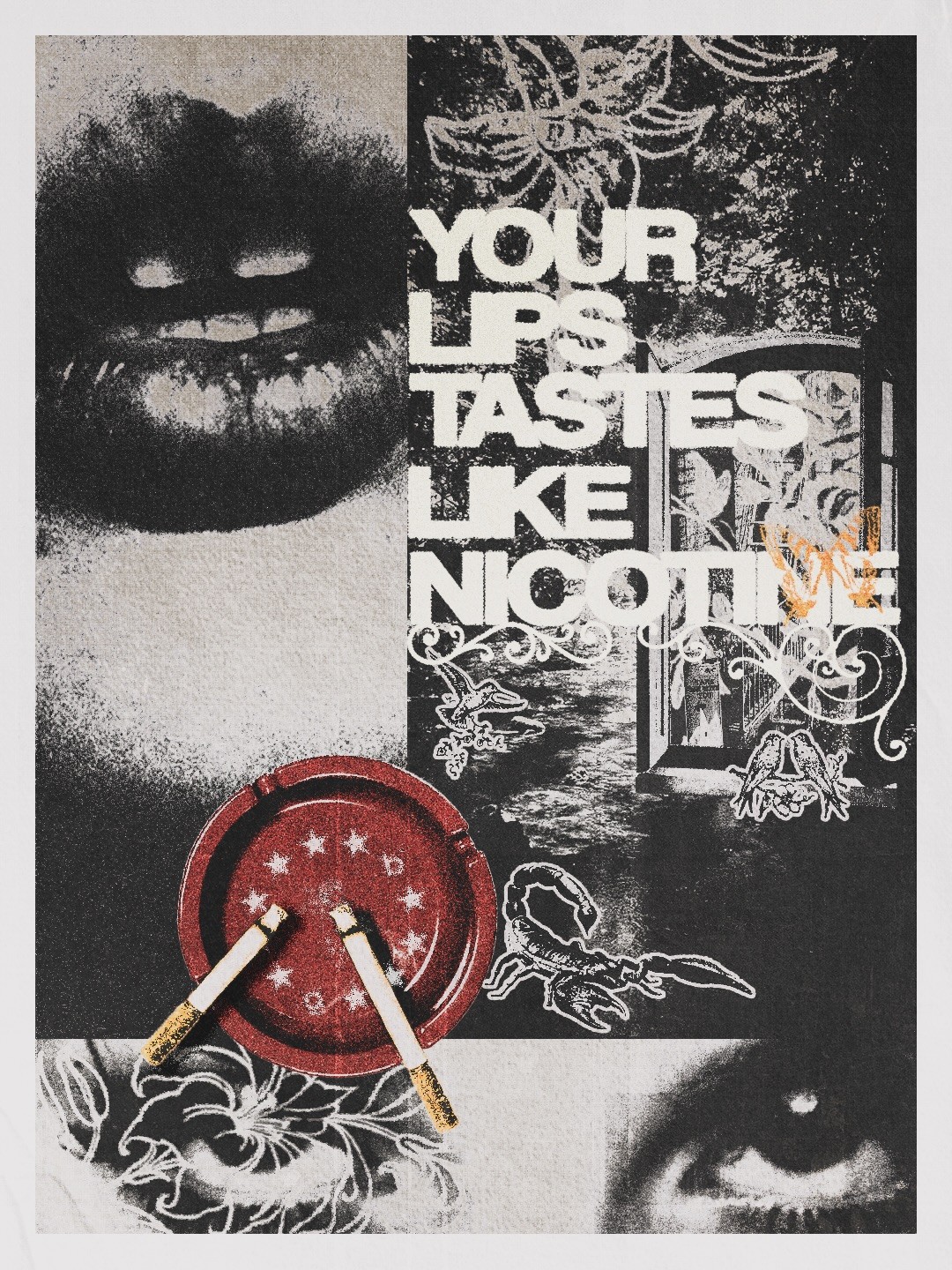
He's been doing graphic design for three years, self-taught out of Toronto, starting from covers for friends who made music and building from there. His dad wanted him to be an electrician and he'll tell you directly that becoming that would have brought good money, a house, a car, maybe a wife. He'll also tell you he would not have been himself. Graphic design is his plan A, B, C, D, and E, and he is not particularly interested in entertaining what happens if none of those work out. He starts every piece with a phrase, something with punch and leeway, then layers everything around the feel of it rather than the literal meaning. "Your Lips Taste Like Nicotine" is about cigarettes the way a fist is about fingers.
What makes him interesting is the contradiction he's working inside. His aesthetic reads as nostalgic: the grain and the analog quality. But he will push back on that directly. He's not reaching backward. He's making work that he believes could only exist right now and can only be fully understood right now.
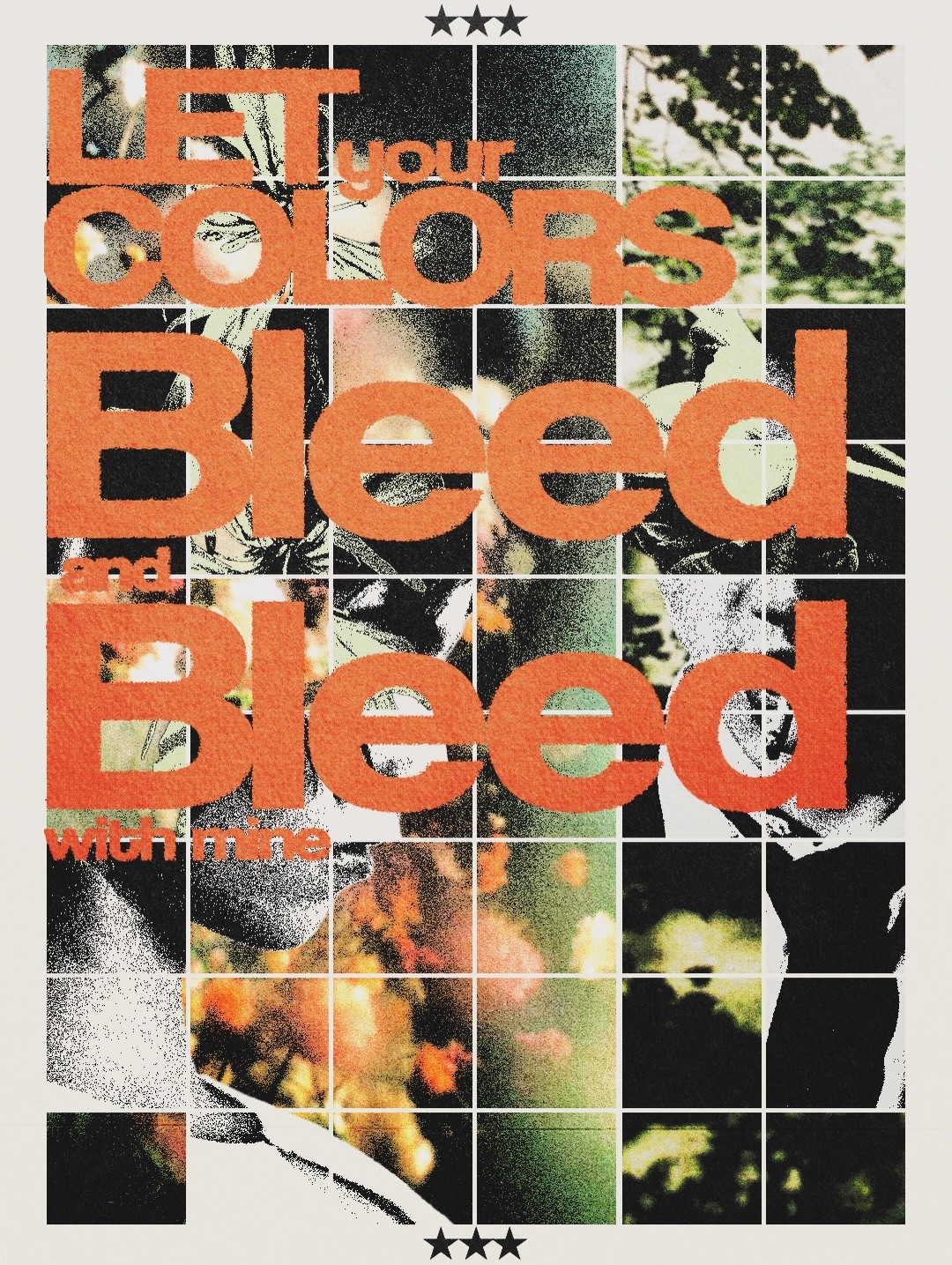
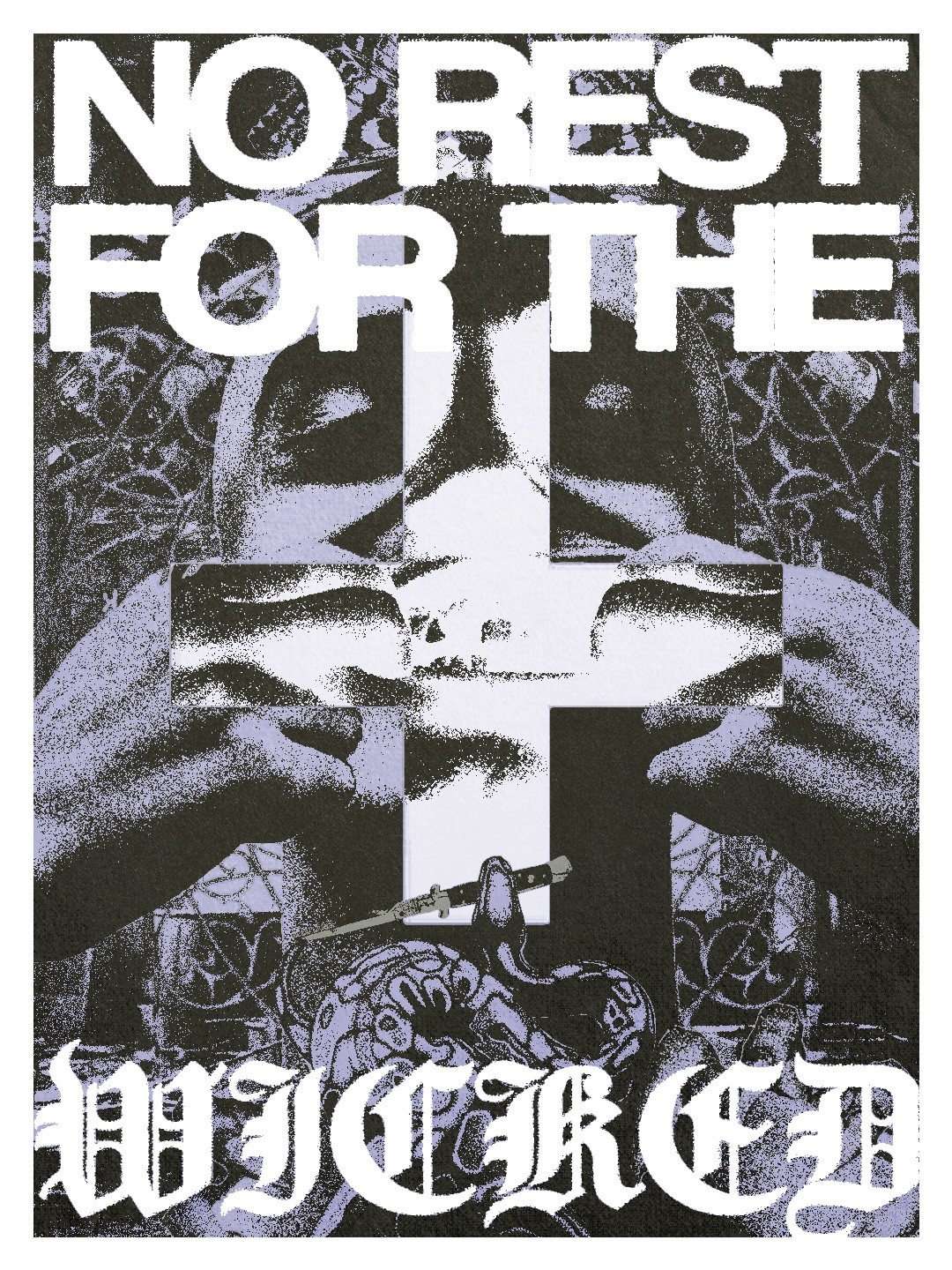
'Let Your Colors Bleed and Bleed With Mine', 2026
Where do you find your inspiration, and how do you know when you've moved past your influences?
A lot of the inspiration I take is from magazines. I like to look at other artists' work. Not base myself on it, but inspire myself, to see where the game is at. My biggest inspiration growing as a graphic designer, to this day, is an artist called Piper Ferrari. She is amazing. At the start I used to do a lot of my works inspired by hers, but then I started driving myself off of that while still staying on that foundation. There are a lot of artists I draw inspiration from.
I like to see art in movies, posters, and shows because graphic design is everywhere. It's as important an art form as painting because you see it everywhere: posters, advertisements, walking around on the road. You may not realize it, but it is. I like to take my inspiration from that and from life too. For example, I see a very cool wall, I could use that. A lot of inspiration comes from pretty much everywhere, but the main part is from other artists like me.
You work almost exclusively with texture. Has it ever felt like a limitation?
100%. I adore doing that [texture]. It's grown weird because I am so used to doing artwork with texture that when I try doing it without, it looks funky. It just doesn't sit right with me. I feel like it looks good, but I could do better. There are so many different ways that you could texture your artwork, and I've seen some people do it insanely well. My main things in my work are 100% the textures and the composition. And I am self-taught. A lot of the things I know I've had to figure out for myself, from tutorials and trial and error. Composition is something I'm going to be completely honest about: I haven't completely mastered it yet. For a lot of the compositions I do, it's very basic, if I think it looks good, then I'm chilling. Same thing with color grading and the choice of colors. I choose mostly to do monochrome, black and white, gray and white. But if it looks good to me, then it looks good to me. That's all that matters, because I'm not trying to satisfy anyone other than myself.
When did you start using collage and texture? When did this style come about?
The texturizing and collage idea came from the very beginning, with my earliest artworks, because I feel like texture walks alongside a good design. Don't get me wrong, there are a lot of designs out there that don't use texture, typography, for example, is a very big one. A lot of artists don't feel the need to do texture. All the power to them. But I have been using this style and collage since the very start. There wasn't really a moment where something snapped in my brain and I was like, "Yeah, I'm going to start doing collage." I always did it.
It's funny because when I try doing other styles, like typography, for example, I feel like it's a little bit harder for me because I'm so used to doing one thing that when I try another, it kind of turns my brain upside down. That's not something great for an artist, because you want to focus in one style while also having some knowledge in others. That's something I really want to work on.
What made you want to get into graphic design?
I started doing graphic design because of my music friends. They do a lot of music and they needed an art cover. I always thought that graphic design was pretty sick and always wanted to try, but I have a very hard time catapulting myself into new hobbies. It's hard starting something from zero, especially without a strong motivation. But my friends needed a cover, so I offered myself. "Yeah, sure, I'll do it." I still have it on my Instagram. It was my first ever piece.
That was the start, and ever since then I kept doing covers. Then I thought, you know what, I'm going to try doing more than just covers. So I started doing posters and other types of designs until I stuck with one specific piece, my black and white one. I feel like that was the change. That was the start of a new era for me, because before that I was doing everything all over the place. The concept was there, but it was still blooming. After that piece, something changed and I started taking graphic design seriously. I was like, I have talent in this. I feel like I have the capabilities of doing something great, and I just started trying to take myself more seriously and go from there.
Where do you get your images from?
Honestly, a lot of designers might come for me for this, I get a lot from Pinterest. I've heard good things about Cosmos, but I honestly have a hard time using it, and transferring everything from Pinterest over, especially after using Pinterest for so long, is kind of bothersome. For client work, I use Unsplash, it has copyright-free images. But the best thing about graphic design is that you can take something and make something else entirely out of it. So you just go wild. My main source is Pinterest.
Walk us through how a piece starts. Where does your eye go first and how do you land on the text?
For all of my works, I start with the text, because I love text work and typography. I start with the text, then I build my design around the feel of that text, not necessarily the text itself, but the feel. For example, my most recent piece before this latest one was "Your Lips Taste Like Nicotine," and I built something based around the text, not literal on the text. I like to play a lot with feelings and moods.
For text, I look at movies, shows, stuff that I think sounds cool. I'll think to myself: what would be nice for this piece? And I think of something that could match. For example: cigarettes. It's kind of cool, but I could make it cooler. Not corny, but something that packs a little more punch. "Your Lips Taste Like Nicotine." It has cigarettes. It has a punch. And it has a leeway for me to make a cool design. It's a three-in-one.
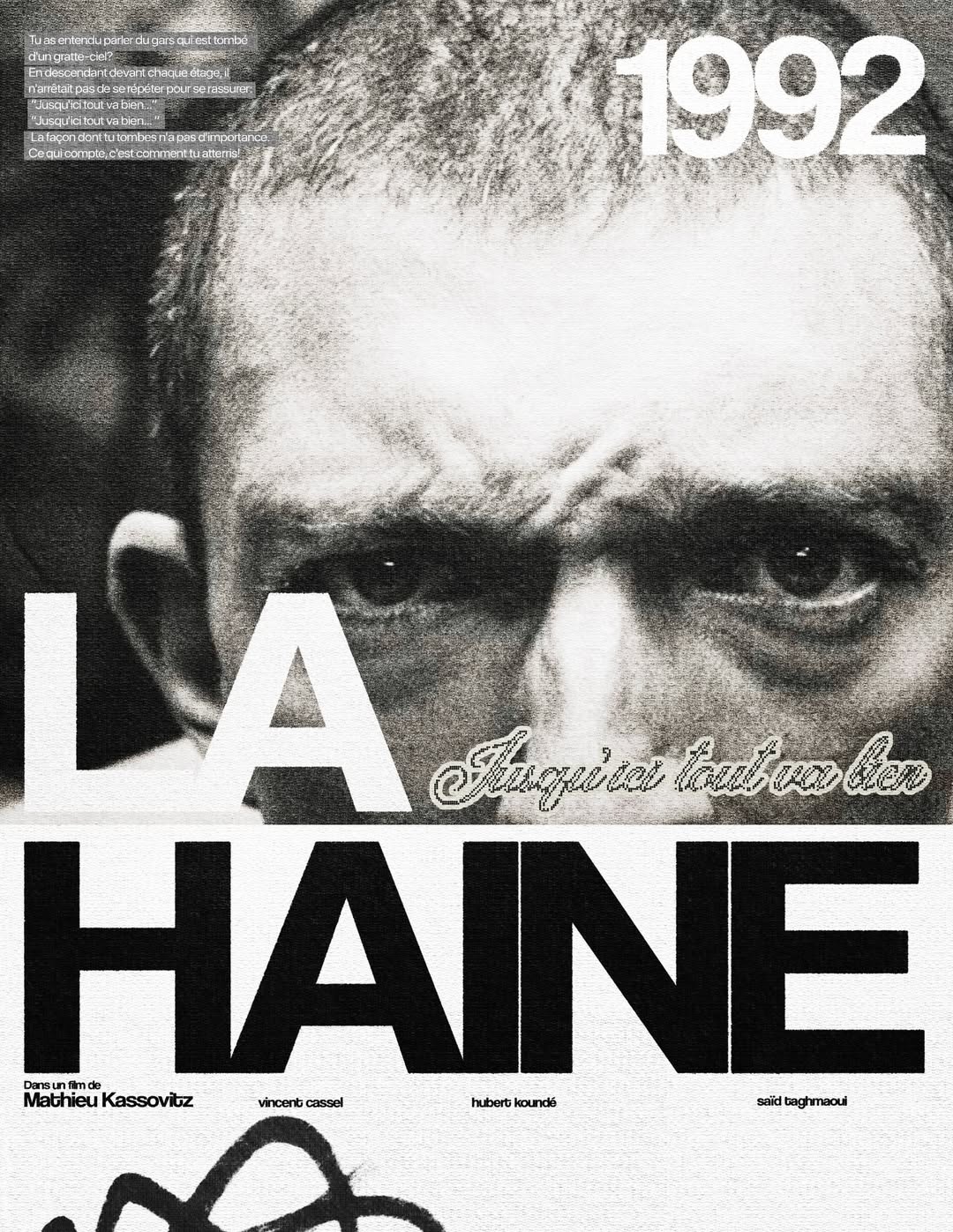
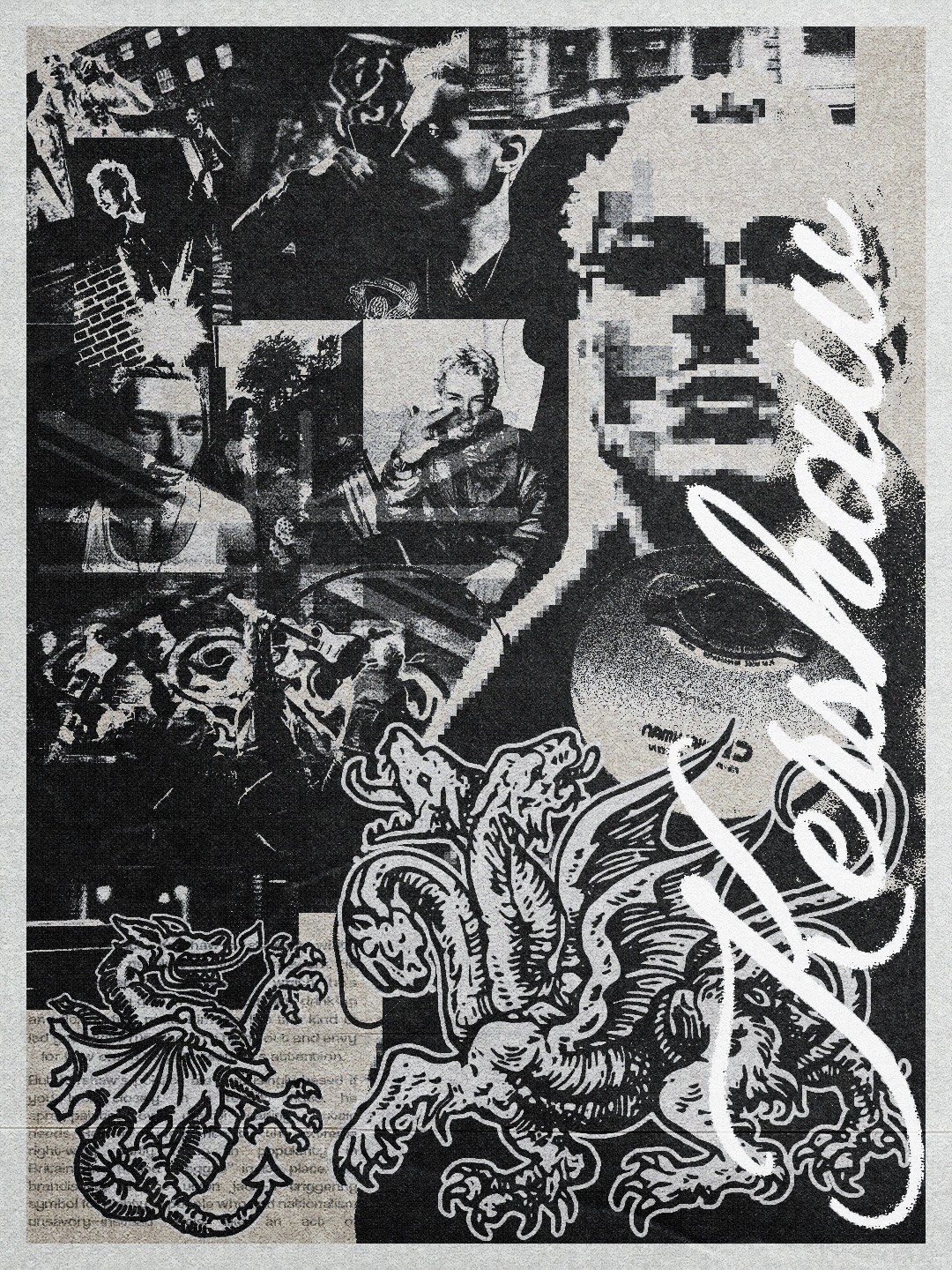
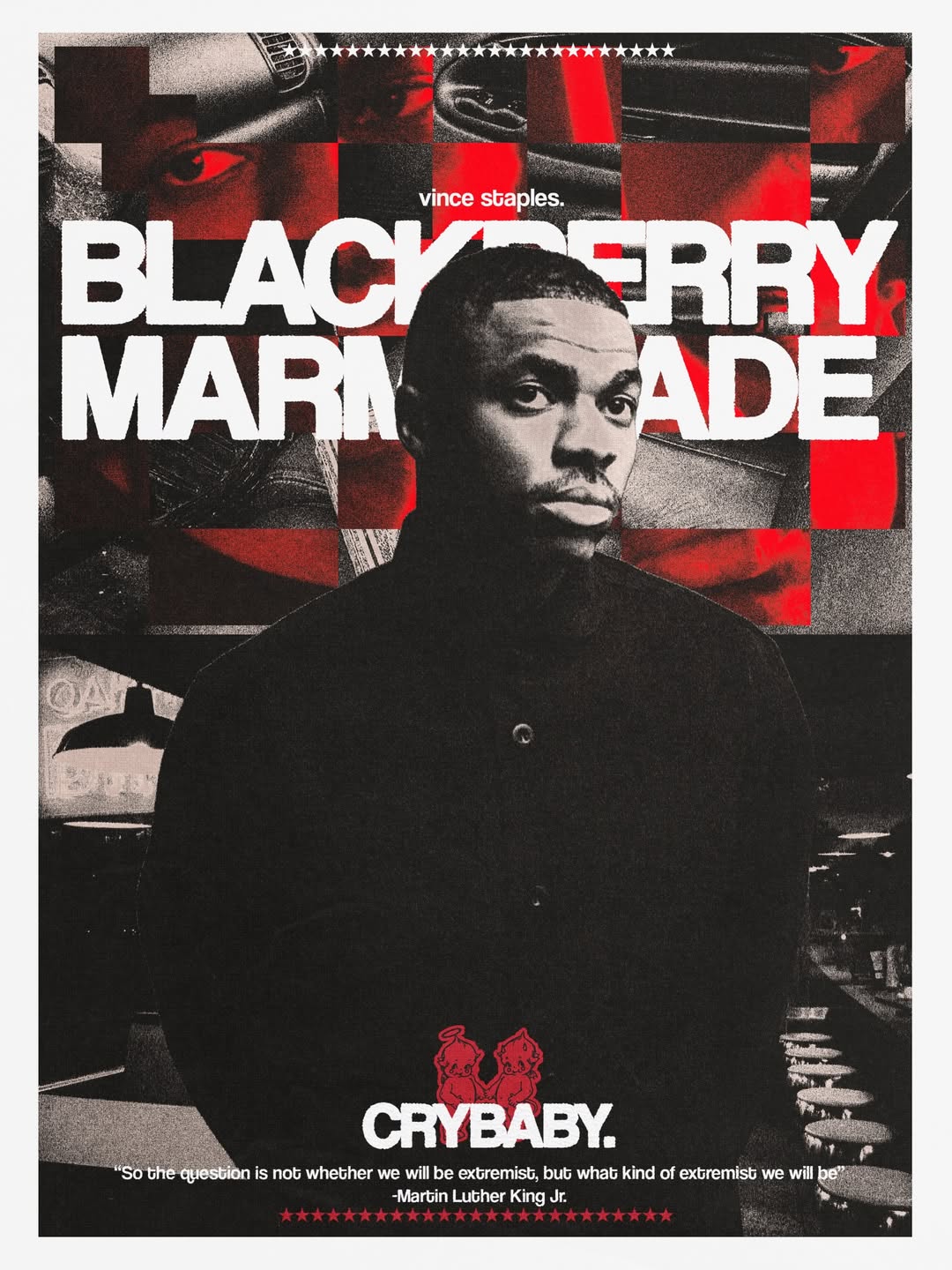
'La Haine Movie Post', 2025
You also use a lot of distortion in your pieces. Why do you gravitate toward it and what are you trying to say with it?
The reason I gravitate toward distortion and threshold is that that's where I can speak the most, because I like how it looks. It looks fantastic, especially in higher resolutions. What I'm trying to say is, honestly, I like to use the threshold to display the art style rather than the message. But don't get me wrong, there is a lot of work I've done where the distortion carries a message too. For the most part, I do it for art. Art doesn't necessarily have to have a message. Of course a lot of them do, and a lot of mine do, but you can make art without a specific message behind it. The threshold, the distortion; I do it because it completes the artwork. It's the puzzle piece that I need.
Your compositions feel violent. Is that the intention or a byproduct of how you work?
It is intentional. I like to make my art based on, not violence exactly, but more so unpredictability. Although I'm not fully proficient in composition, I know the bare bones basics, and I try to build on that footing. I like to make unpredictable works because it gives that edge, it makes it stand out.
But I don't really do it thinking, "if I do this, people will totally look." I tend to gravitate more toward this unpredictable, shaky art because I like to vent and portray my feelings through my pieces. Even if a piece might not display the exact feeling I want to display at the moment, for example, I might be feeling anguish but making a piece about something else, those feelings can still bleed into how the composition looks.
One of my favorite things is making pieces with messaging that isn't obvious. I like to leave a little space for people to think, because if I lay everything out for them, it's kind of boring. It makes the art linger. Most of all, it makes them care about it.
Do you worry about people misreading the imagery?
Honestly, a little bit. Especially when the messaging is a little close to home. I'm not a very political person, but I have my positions, and I've considered many times doing designs based on those, especially with everything going on in the world. I feel like it could carry such a beautiful message, but what scares me is portraying it in a way that isn't sensible and having it all fall apart. It's not because I'm scared of what people will think of my image, but mostly because of what I will think. I could look at a political artwork right now and be like, okay, this is good, it produces a message, I like it. But I could look at it a week later and realize it's insensible. That freaks me out a little bit.
But it's something I want to let go of, because I do want to portray these messages. I feel like my job as an artist is not to sit on the fence. Art is not all sunshine and rainbows. Art is for you to display thoughts, feelings, everything; movies, drawings, shows, any sort of art, graphic design included. It's something I really want to get into in the future.
When using text in your designs, when do you decide something should be left implied versus being more direct?
Maybe I'd do a 50/50. Doing a fully direct piece would be kind of boring. Maybe I could do a quotation or something that references the subject rather than a full statement, because a direct reference can mean just as much as a statement, especially with what you do with the design and the composition around it. So I'd lean more toward a hard reference toward the situation rather than a direct statement. Or I could go 50/50, a direct statement in one piece and a reference in another.
Where do your textures come from, and is the scanner work on your Instagram the direction you're heading?
I tend to use a lot of dirty textures. I use paper but not flat paper, crumpled. And grain. Grain is a very big one. For now, those are my main ones. I have a whole file of textures I could pull from, but I tend to stick with those two because they're the ones I know the most. I've tried others, but I just don't like how they look. The paper and grain are the ones I feel most comfortable with and have the most proficiency using.
On the scanner, yes. But that is a very tragic story. After I posted about it, the scanner started acting funny on me. When I click it, it scans for three seconds and doesn't register, and when I try again it only captures a strip of the image. I've got to do some troubleshooting.
But to answer your question, yes, that is the direction I want to go. I did a mixed media piece where I printed some pictures, arranged them, and scanned them back in. That's when it was still working. The magic of the scanner is that you can show the audience a glimpse of how you see the world. The things you scan are the things you find interesting, the things that catch your eye. There's so much around the world that you might find cool, and with a scanner, or even just a high-quality phone camera and you can capture it. I want to do my own textures sooner than later. I just really have to figure out what's going on with this scanner.
Do you feel like your work is nostalgic or does it reject nostalgia?
Funny you say that, because I did a nostalgia piece before, it's kind of whack, I might remake it. But I feel like my work rejects nostalgia, because I know nostalgia firsthand and I know how dangerous it can be. I don't want to be strict on nostalgia, but I also don't want to just adapt blindly to modernity. I like to build my art not based purely on nostalgia, because adaptability is everything. I feel like my artwork is something that could only exist in this specific time period and can only be fully understood in this time period.
You can see in history how artists were shunned or mocked during their time, but as society moved forward, those artworks became looked upon highly. I want that for me, not necessarily for my artwork to be timeless, but to walk a balance between timeless and of a specific period. So you can look at it and say, yeah, that was made during a certain time. And if you look at it 10 years from now, it still looks pretty good.
The textures kind of contradict that on purpose, because you see a lot of texturized works from back in the day, and I like to play with that idea, with nostalgia and adaptability and moving forward. It all slowly ties together. I love to play with themes and switch them around. For example, there's an artwork I did called "Bite the Hand That Feeds You", a play on "don't bite the hand that feeds you." It plays on nostalgia through crosswords and imagery, and it's about adaptability, about living in a modern space rather than being stuck in the past. We as humans are not made to live in the past. A lot of people don't understand that. I like to live in the present and look to the future, and I want my artwork to reflect that.
Your pieces feel very tied to youth culture and counterculture. What are you trying to capture about that?
It sucks. It all sucks, really. People my age, it all sucks. People are too sterile. Too used to the same stuff, the same movies, the same things. They're too scared to accept reality and just move on from there. They'd much rather live in a shared bubble than break it. People don't delve into art the way they used to, and that hurts the world. People don't value art the way they used to.
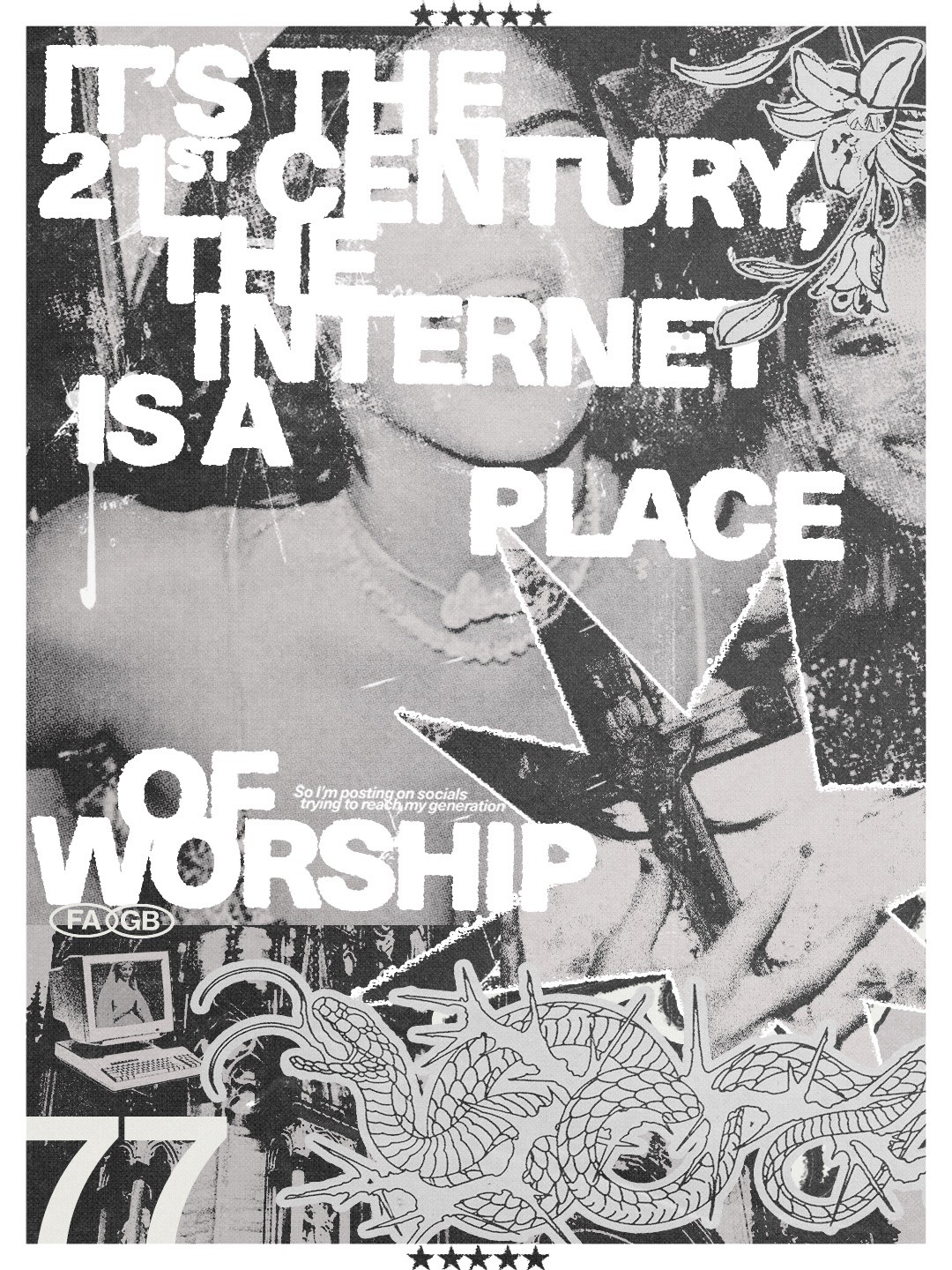
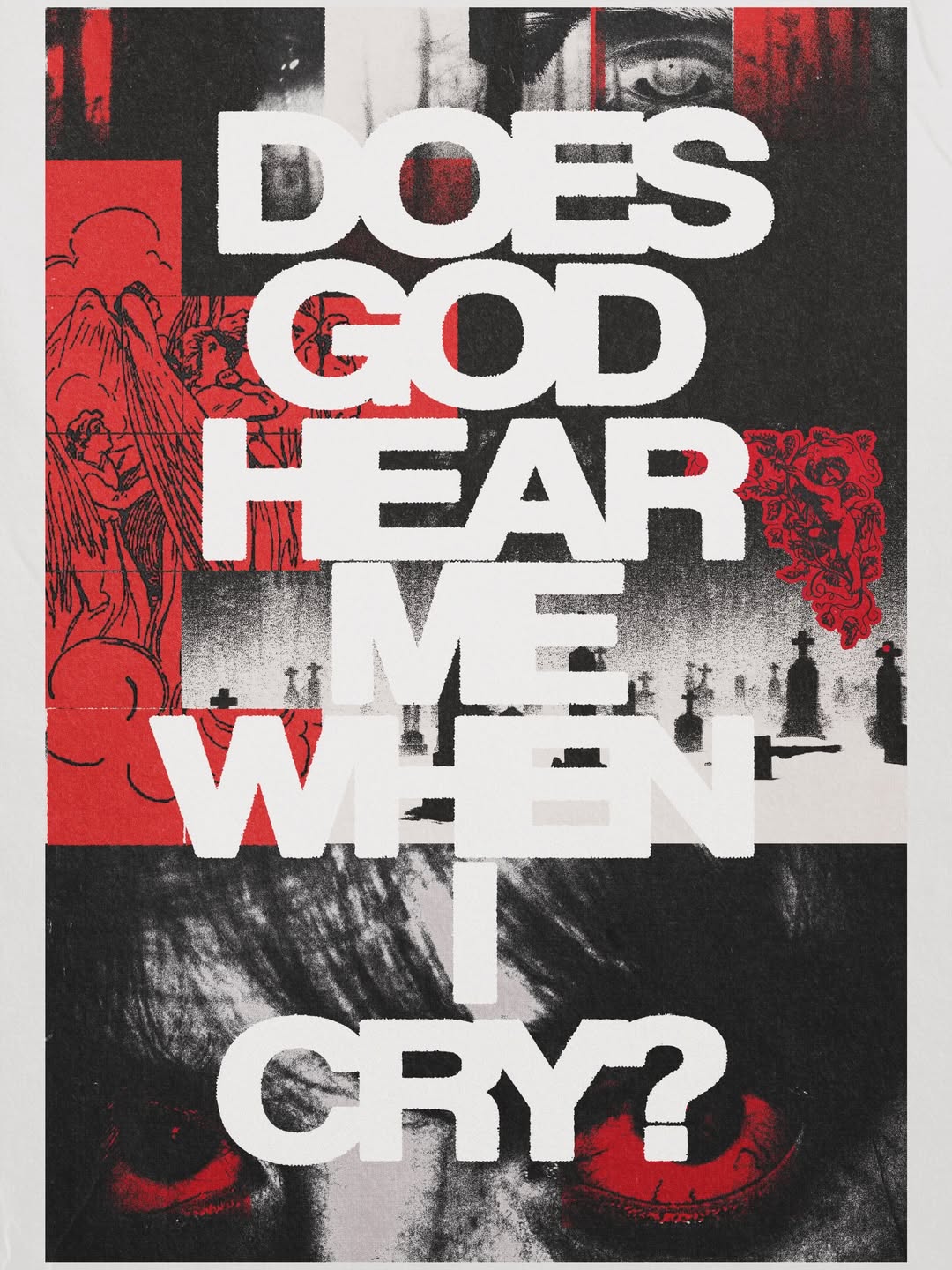
I like to portray my artwork as a sort of counterculture because of that. A lot of the artworks I've done are built on that base. For example, something I absolutely hate is the concept of nonchalance, not caring, being chill without showing passion, without showing anything. You're nothing but a husk, just walking around. Unfortunately, a lot of people my age are just like that. They love being husks. My work directly contradicts that manner of belief.
Do you feel like your work is sincere?
Yes, 100%. All of my works share a bit of the truth of who I am. A lot of them, especially through the text, I drive from what I believe in and what I feel. A lot of them are for aesthetics. I'm not going to lie. "Your Lips Taste Like Nicotine". I smoke, but I felt that sounded pretty cool. But for a lot of others, there's real belief behind it.
"All Beauty Will Die Someday" is based on the belief that our generation changes how they look a lot, with plastics, with surgeries, nothing against that, but I am a firm believer in loving who you are, in being sincere with yourself. What you see in the mirror is what you get. That title means that no matter how pretty you are, no matter how much work you do on yourself, it will not matter in the end. It's not meant in a rude way, all the power to people who do plastics, I love them, but it comes from a place of acceptance, of being sincere with yourself. We will be who we were in our lives, and it's up to us to make that the legacy of who we were.
What would it mean to you if this didn't work out?
I really want my works to be a legacy. I don't want to be the greatest graphic designer of all time, but I want to be great on my own terms. And I want to inspire people to do what they want to do, because it's possible. I've done it. I'm self-taught. I'm not saying this to sound cool, but in a way you can do it. If I can do it and get to where I am now, which isn't anything crazy, but for me to get an interview means I'm doing something right.
My dad, he was very hesitant, he's a conservative man who wanted me to be an electrician. And no, that's not where I'm at. Becoming that would bring a hell of a lot of money. I'd have cars, a house, maybe a wife. Sure. But would I have myself? Would I be happy? I don't think I would, because that is not who I am. Who I am is art. I am a graphic designer. I love graphic design. Graphic design is me. My plan A, B, C, D, E; whatever, it is graphic design. And if it doesn't work, I will make it work. It doesn't matter how many times I fall. Doesn't matter how many times I get told no. I will make this work.
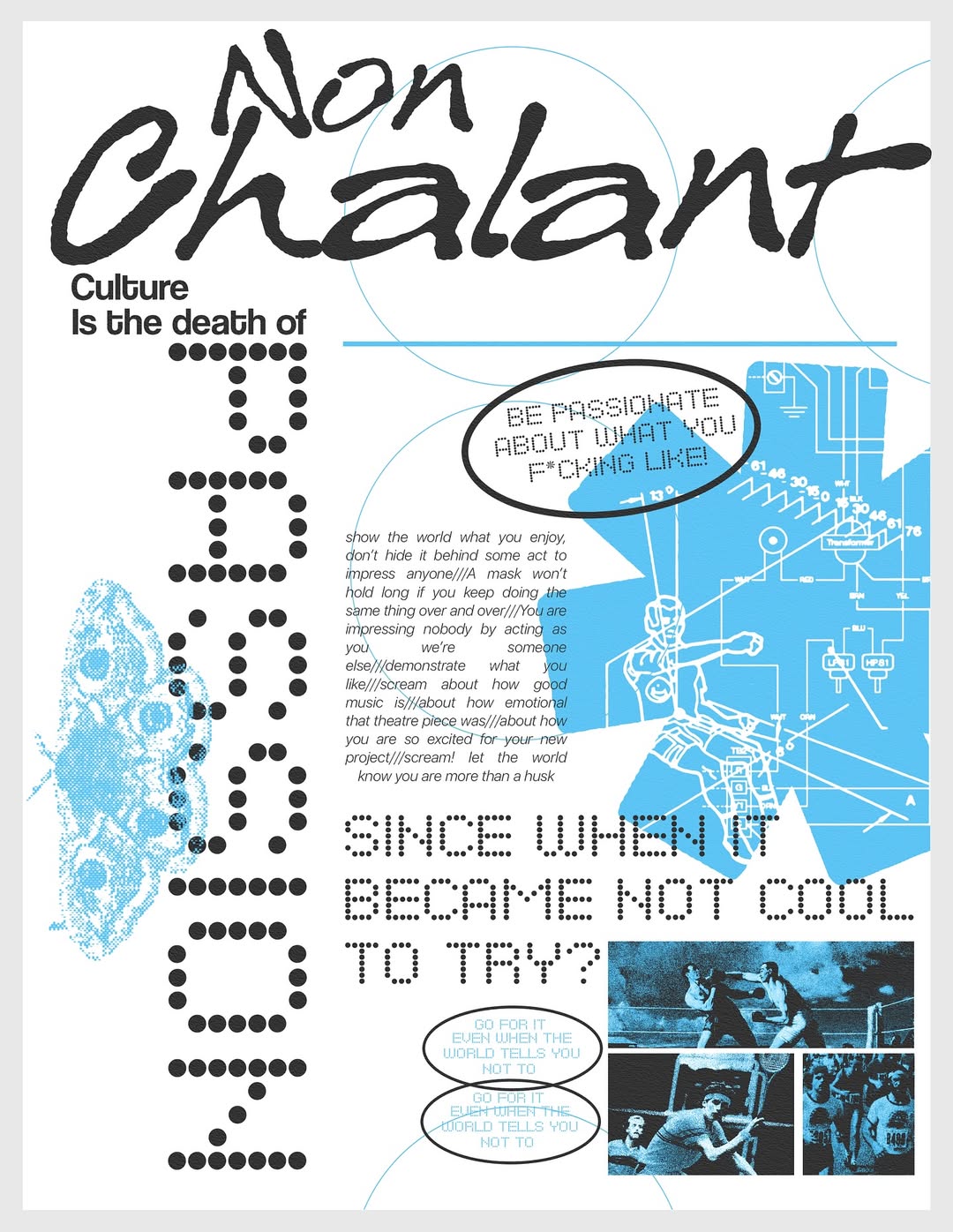
'Nonchalant Culture is The Death of Passion', 2025
How did you teach yourself graphic design?
A lot of what I've learned came from grabbing something and twisting it, like trying to figure out how a device works. You're told this is how you turn it on and off, but there are so many more buttons. You start figuring out: what does this one do? What does that one do? That's how I teach myself, in a nutshell.
Texturing, for example. I saw a guide on Pinterest on how to texture. I tried it. The way he did it worked for him, it didn't really work for me. But I kept using that method for a long time. Then I tried something else. What if I modify the image before changing the blending mode? I tried it, and it looked better. Everything I know is a bundle of things I've seen and adapted on my own. A tutorial on one thing opens gateways to learning other things.
I still don't know a lot. There are so many things in Photoshop I have zero clue on how to use. And that's the magic of it, you never know 100% of what you're doing. That's the best part. I know what I'm doing maybe 70, 75% of the time. At one point I just drive myself off the inspiration and do my own thing. Do I know what I'm doing? I don't know. Maybe at the end, when it's all completed, I will.
What reaction do you want people to have to your work?
"Whoa." That's pretty much it. I want people to enjoy my work as much as I enjoy making it, and I want to build an audience from that. I don't necessarily want to be super famous. I don't want to be the graphic design guy walking around the city and having people say, "Yo, that's Genesis Bullets." But I do want to inspire other people. That's my main objective. As much as Piper Ferrari inspired me.
Genesis Bullets is working with a level of conviction that feels rare at his age. There’s no hesitation in the way he talks about what he wants or what he refuses. That clarity shows up in the work, in how direct it feels even when the imagery is fragmented and difficult to fully grasp. You get the sense that every piece is an extension of something he already believes, not something he is trying on to see if it fits.
What makes his work hold is that it does not rely on nostalgia or trend to carry it. The textures, the distortion, the chaos all point back to a specific point of view about the present moment and the people inside it. He is reacting to a culture that has flattened itself and choosing to make something that resists that flattening. There is risk in that, especially when the work is tied so closely to who he is, but that is also what gives it weight.
He talks about legacy without making it sound distant. Not in terms of recognition, but in terms of impact and honesty. If the work continues in this direction, it will be because he refuses to separate himself from it. And right now, that refusal feels like the most important part.

Articles
Magazine
Submissions